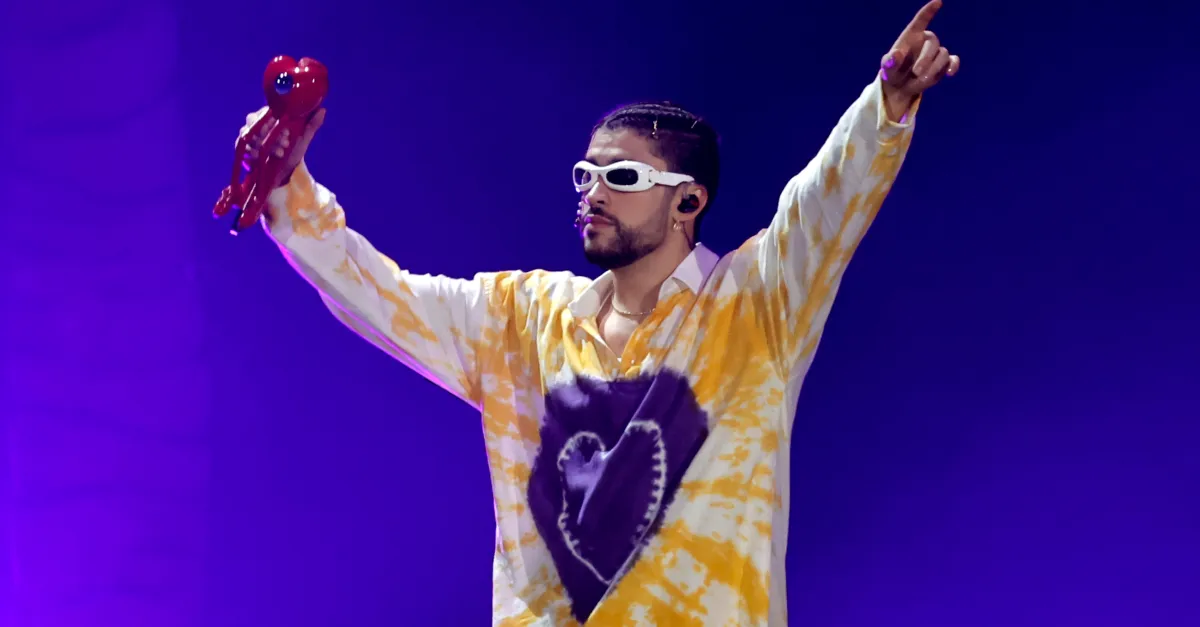
Rapper Bad Bunny will perform Sunday at the Super Bowl halftime show, becoming the first solo male Latin American artist to headline. He’s arriving at the peak of his popularity: The performance comes just a week after receiving the Grammy’s highest honor for his genre-defining album, Debí Tirar Más Fotos, which deals with themes of colonization, gentrification, and difficult relationships, all while honoring the diverse roots of Puerto Rican and Latin music across the diaspora.
The 31-year-old superstar, born Benito Antonio Martínez Ocasio, is also developing a reputation for his outspoken politics. He’s refused to tour in the United States since President Donald Trump took office again, for fear of exposing Latino fans to ICE raids.
“Before I say thanks to God, I’m gonna say, ‘ICE out!’” Bad Bunny said while accepting his Grammy for Best Música Urbana Album. “We’re not savage, we’re not animals, we’re not aliens. We are humans, and we are Americans.”
Key takeaways
- Bad Bunny’s music has a hard political edge and frequently deals with Puerto Rican politics. He became an icon among activists calling for independence from the United States after supporting Juan Dalmau, secretary-general of the Puerto Rican Independence Party (PIP), in the 2024 governor’s race. Dalmau came in second place, which was considered a new high for the independence movement.
- Bad Bunny is part of a disaffected “crisis generation” of younger Puerto Ricans whose experience with natural disasters, economic crises, government scandals, and clashes with Washington over austerity measures and disaster aid inform many of his songs. He has not explicitly endorsed independence, but his cohort’s experience is seen as a key reason for its revival.
- There are major barriers to Puerto Rico declaring independence, which supporters favor doing peacefully through a negotiated process. More Puerto Ricans so far prefer statehood, which would give residents representation in Congress and more control over their affairs. And some prefer remaining as a commonwealth to keep Puerto Rican culture more distinct from the mainland, and maintain certain economic benefits like exemption from federal income tax.
The president is not a fan. “I’m anti-them,” he said of Bad Bunny and fellow Super Bowl performers Green Day, who have also been critical of his administration. Earlier, Trump claimed not to know who the Puerto Rican artist even is, calling his halftime selection “absolutely ridiculous.”
He should probably start paying more attention.
While Trump has been obsessed in his second term with expanding the US into new territories like Greenland, or even Canada, his neglect of Puerto Rico is ironically one factor in reviving a long-dormant independence movement there. And Bad Bunny is considered one of the most high-profile cultural figures who will help determine just how far it can go.
How Bad Bunny became the biggest endorsement in Puerto Rico
While casual listeners may have first learned about the artist’s activism when he called out ICE onstage last week, Bad Bunny’s outspokenness is nothing new. And he’s been especially engaged with the archipelago’s unique politics.
As Bad Bunny reminded Grammy viewers (and apparently some confused NFL players) in a jokey bit with host Trevor Noah on Sunday, Puerto Rico is “part of America” — a phrase he said with air quotes. The United States gained control of Puerto Rico in 1898 at the end of the Spanish-American War, granting its residents citizenship in 1917. The archipelago adopted its own constitution in 1952, officially becoming a self-governing US territory with an elected governor.
Since then, Puerto Rico’s two historic major parties have divided themselves in part based on the question of its status. The New Progressive Party (PNP) is historically pro-statehood, which would give Puerto Ricans voting representation in Congress and in presidential elections as well as more control over their affairs. The Popular Democratic Party (PPD) typically favors remaining as a commonwealth, which supporters argue will allow Puerto Rico to better maintain its unique culture along with US citizenship and certain economic benefits, like an exemption from most federal income tax.
In 2024, the governor’s contest featured Jenniffer González-Colón, a former Resident Commissioner who caucused with House Republicans, on the PNP ticket. Jesús Manuel Ortiz ran for the PPD. But the election featured a surprising third-party dark horse, Juan Dalmau, secretary-general of the Puerto Rican Independence Party (PIP), which favors independence from the United States after a period of transition.
González-Colón loves Trump. Bad Bunny despises him. So it was no surprise that they were at odds. The singer sponsored anti-PNP billboards with messages like, “Quien vota PNP no ama a Puerto Rico” — “someone who votes for PNP doesn’t love Puerto Rico.” But he also went further by publicly rejecting both major parties, who he said were jointly responsible for Puerto Rico’s struggles — and instead directed fans to vote for Dalmau at the candidate’s closing rally.
While González-Colón won, Dalmau more than doubled his share of the vote from the prior election and ended up in second place with 31 percent of the vote after allying with another minority party, a performance that was considered a massive step forward for the party and independence movement.
Independentistas are still fueled by momentum from their second-place election results, dissatisfaction with the federal government’s lack of investment over the past decade, and, yes, Bad Bunny’s album about Boricua culture and history. The rapper’s breakout success and political voice have cleared a space to spread their message further — even as he steers clear of explicitly calling for independence himself.
“The political landscape in Puerto Rico is changing, regardless of what’s happening in the United States,” said Jorell Meléndez-Badillo, an associate professor at the University of Wisconsin-Madison who collaborated with Ocasio on his album rollout, providing historical context and guidance to the artist. “We need to hone that, and that gives me some hope as well.”
Why the independence movement is on the rise
Puerto Rican independence movements — including limited armed resistance in the 1950s on both Puerto Rican and US soil — fluctuated in their reach over the 20th century depending on the political moment, but were considered marginal until recently.
But the surge of interest in independence, while still a clear minority position, is partly seen as a story of younger voters’ disillusionment with the government. Bad Bunny is a part of Puerto Rico’s “crisis generation,” a cohort of Boricuas who experienced high financial fragility, austerity measures that stagnated the archipelago’s economy, political corruption, natural disasters, school closings, and the effects of gentrification within a short period of time. His journey as a former grocery store bagger and university dropout to one of the world’s biggest artists is directly tied to those struggles, Meléndez-Badillo, the Wisconsin professor, said.
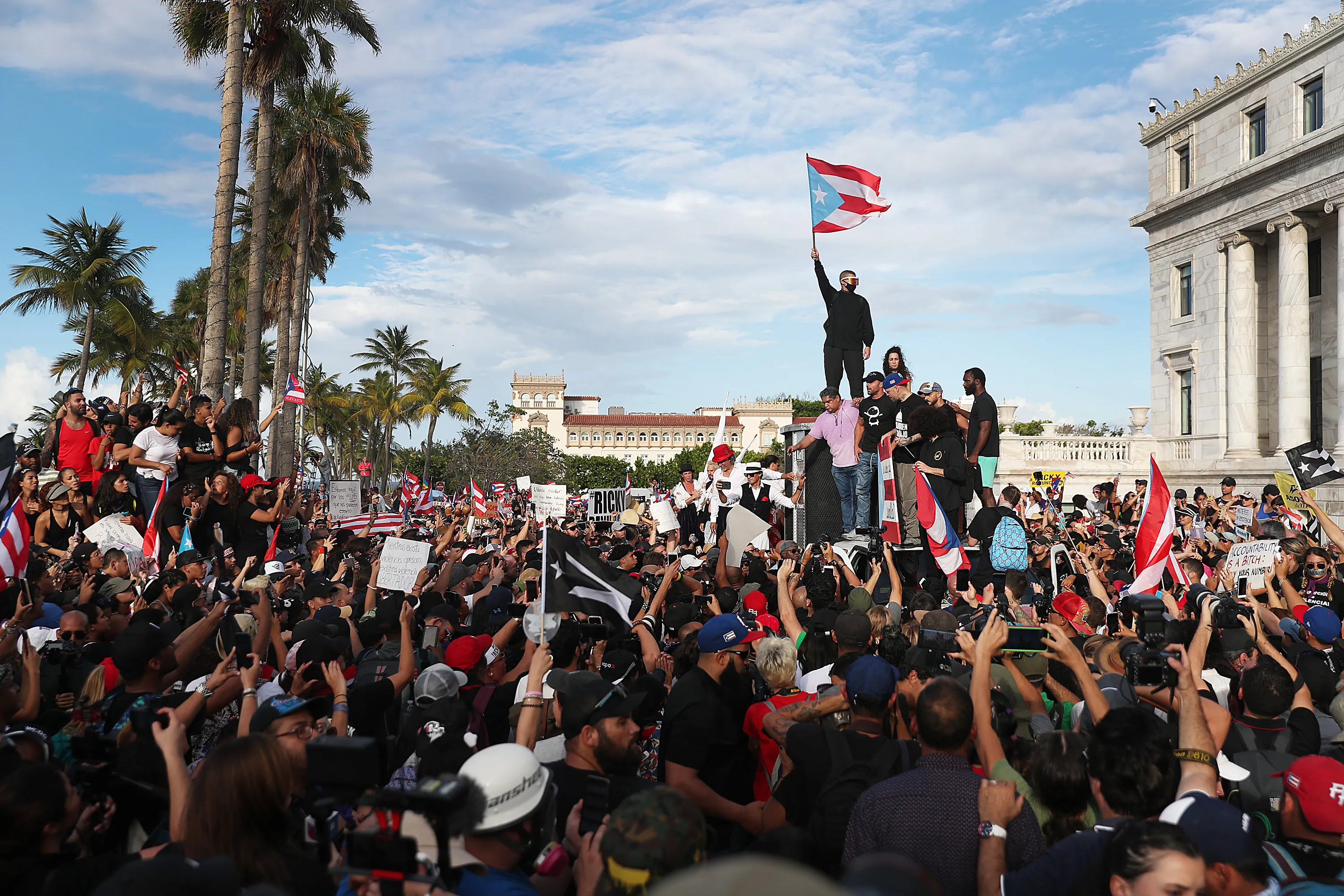
Bad Bunny’s songs frequently explore these topics. His 2019 protest track “Afilando Los Cuchillos,” with legendary Calle 13 members Residente and iLe catalogued a generational frustration with corruption, and became an anthem at mass protests against then-Gov. Ricky Rosselló — a pro-statehood official who resigned after a trove of Telegram messages leaked that were filled with inflammatory, sexist, and homophobic statements. His anthem “El Apagón” notes the pride Boricuas have amid constant blackouts, while insisting they “don’t want to leave here / let them go, let them go.” Even the romantic ballad “Bokete” uses the endless, oft-unaddressed potholes found across the island’s roads as metaphors for an ex-lover who should be avoided at all costs.
Questions of gaining sovereignty have also become more acute as Washington takes a bigger role in its finances. In 2016, Congress enacted the Puerto Rico Oversight, Management, and Economic Stability Act (PROMESA) to help the archipelago tackle over $70 billion in debt. The fiscal oversight board — whose members are appointed by the US president, with no say from Puerto Ricans — quickly implemented austerity measures that critics say impacted access to social services like retirement funds and education.
Residents receive food assistance and health care through capped federal block-grant systems, which are different from the flexible funding pools awarded to the continental United States by Congress that expand to meet increased needs. Those aid dollars go significantly less far on the archipelago because the funding is fixed. Residents also face barriers to shipping through the Jones Act, which raises prices and forces dependency on US trade by requiring Puerto Rico to use American-built and -operated vessels for shipping between the two shores.
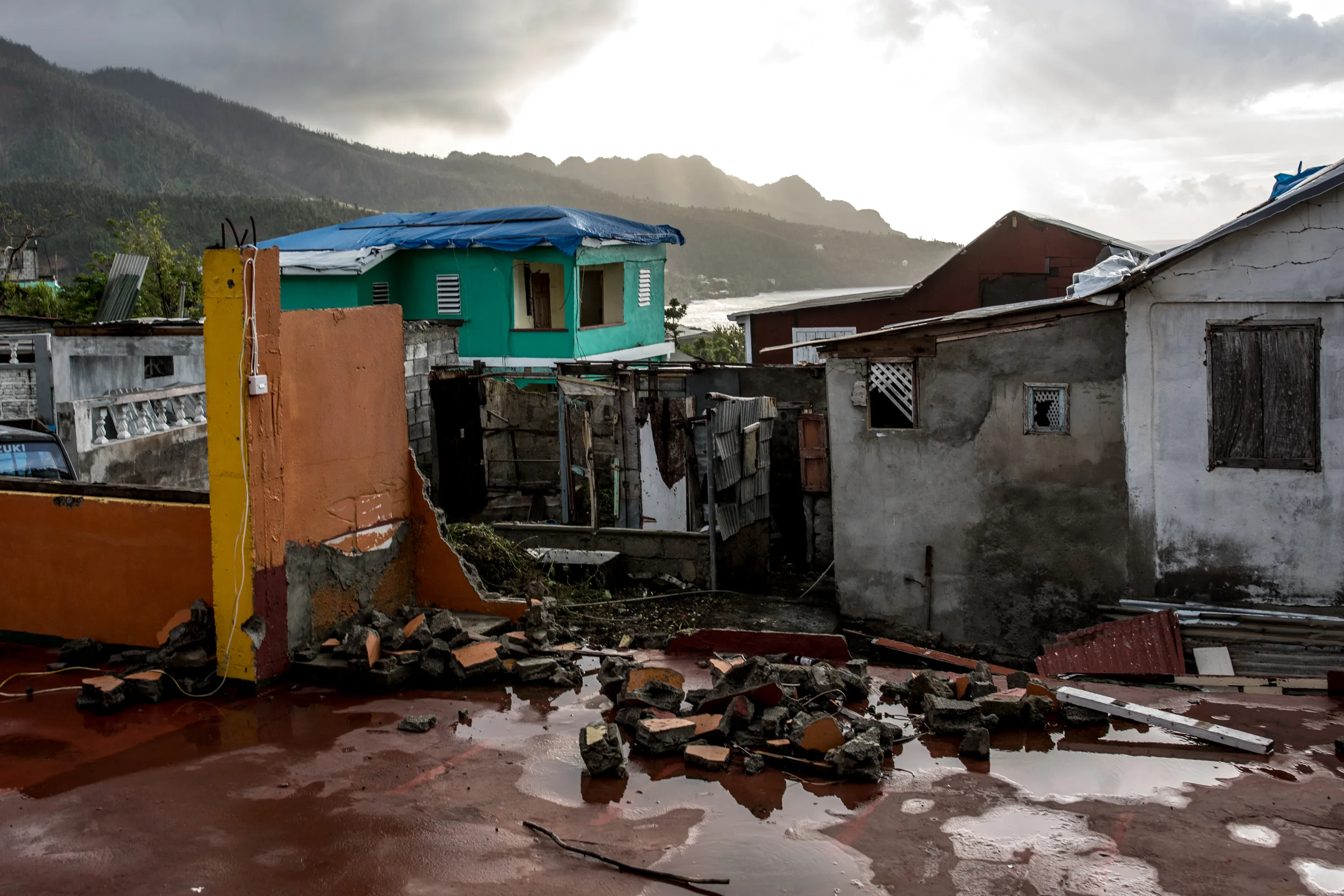
Many point to Trump’s mishandling of Maria during his first term in office as a major turning point for both politics on the archipelago and trust in the US government to handle the territory’s affairs. When the hurricane hit in September 2017 and caused catastrophic ruin to infrastructure and the local economy — with nearly 3,000 deaths and over $90 billion in damages — residents deemed the federal responses beyond disappointing.
One lasting image among Boricuas: Trump tossing paper towels into a crowd during a delayed visit to San Juan as millions remained without power or adequate cellular signals. Two years later, he berated Puerto Ricans for having “squandered or wasted away” their federal funding, even as locals noted much of the promised aid had not yet been disbursed.
“This all goes hand-in-hand with the natural events of Hurricane Maria, earthquake swarms,” Meléndez-Badillo said. They “were massive disasters for Puerto Rico — the hurricanes themselves are natural, but the disasters are human-made. This is all the product of the compounding colonial crises in Puerto Rico.”
Instability has caused residents to move to the US in droves over the past two decades, intensified by the debt crisis and later by Maria. The nearly 6 million diaspora members are almost double Puerto Rico’s current population of 3.2 million, and the ongoing economic and social upheaval could push more to make the same decision.
All the while, Boricuas still face regular and sweeping power blackouts on an aging and damaged electrical grid, and an influx of tourists and visitors who some see as sucking up valuable real estate and resources — issues Bad Bunny regularly touches on in his songs, like “Una Velita.”
“We can’t continue to depend on federal funding packages in a forum we don’t even have power in — we have to beg to get $2 million to repair a highway,” Jenaro Abraham, a pro-independence professor at Gonzaga University, said. “We’re depending on something that is, in and of itself, the disease. It’s like when a smoker is smoking all his life, and doesn’t know how to stop. They feel like they’re going to get sick if they stop smoking. It’s like, well, I think you should probably stop smoking.”
Independence is still a long shot
Independence advocates acknowledge that the process would not happen overnight. They just want the chance to try.
Their solution is simple on the surface: Supporters want to guide Puerto Rico on a series of steps in conjunction with the US, starting with a consensus vote, a lengthy transition, and terms negotiation process with Congress, all leading to eventual sovereignty over affairs.
If that sounds not so simple, you’re not alone in thinking so. Critics have a number of immediate concerns.
Boricuas could lose birthright citizenship, potentially lowering their ability to travel freely with a powerful passport, an especially major concern given their close connections to large mainland communities in cities like Orlando and New York. There are also infrastructure and logistics issues. Residents would have to finance their own retirement programs, which are currently handled by Medicare and Social Security, even as residents are exempt from income taxes. Puerto Rico has more than double the poverty rate of the poorest American states in a system where many already cannot access adequate social services and face skyrocketing prices at the grocery store.
Self-sufficiency on an archipelago with a failing power grid, remote rural areas, and an agricultural industry decimated by María is still hard for many Boricuas to envision, even if they’re not happy with the current level of federal support.
Some have suggested a “free association” model of independence, which would give Puerto Rico sovereignty in international relations while maintaining some federal aid and still allowing the US military access. Some former Pacific Island territories have successfully split from the US through Compacts of Free Association in recent memory — the Marshall Islands and Micronesia in 1986, and Palau in 1994 — but they have a fraction of Puerto Rico’s population size and economic capacity, and are much further geographically from the mainland.
So far, independence has not been especially popular when put to voters. In six out of seven ballots on the issue since 1967, statehood has always been the majority opinion, reaching almost 59 percent in the most recent 2024 ballot. (Independence with free association garnered 29.5 percent, and independence alone just under 12 percent.) However, these polls are never conducted the same way. The 2024 vote didn’t include the status quo as a choice, for example, instead only giving options presented in the House’s Puerto Rico Status Act from two years prior: statehood, independence, and sovereign free association. In 2020, voters chose between a simple “yes-or-no” vote on statehood, with “yes” winning out narrowly with 52.5 percent of the vote.
Resident Commissioner Pablo José Hernández, who belongs to the pro-commonwealth Popular Democratic Party, wrote in an op-ed in the Wall Street Journal in October that Puerto Ricans’ relationship with the US was similar to that of Quebecois in Canada or Catalonians in Spain — they’re protective of their distinct culture and don’t want to see it subsumed into the US by becoming a state.
“Then why not pursue independence?” he wrote. “Because Puerto Ricans value their US citizenship, close ties with the mainland, serving in the armed forces, and contributing to the American economy.”
Independence supporters argue the relationship is more like a colonial chain around Puerto Rico’s neck.
“Sometimes there’s some slack in that chain, and it’s a bit loose, and it seems like Puerto Rico is not suffering too badly, or maybe has some leeway to make its own decisions,” said Alberto Medina, who leads the pro-independence Boricuas Unidos en la Diáspora’s board of directors in the US. “But at any time, the US can give that chain a very powerful yank and remind Puerto Rico who’s really in charge. Trump has been a prime example of some very, very painful pulls and yanks on that chain.”
Where independence supporters see Bad Bunny’s impact
For his part, Bad Bunny’s stance on statehood seems clear — he does not want it. In an emotional hymn off DTMF, the artist mourns “Lo Que le Pasó a Hawaii” — “what happened to Hawaii,” which became a state in 1959. (“They want to take away the river and the beach / They want my hood and for Grandma to leave / No, don’t let go of the flag nor forget [our cry] / I don’t want them to do to you what happened to Hawaii.”)
“Bad Bunny has done such a beautiful job of making Puerto Rico be seen.”
Kiara Zamot, 21-year-old student
Independence proponents are hoping that Bad Bunny’s more direct participation in the political process will lead to increased interest in the issue among his many fans both on the archipelago and on the mainland. In Puerto Rico, the rapper personally urged disaffected young people to register to vote; activists also want to focus on registered voters in the US, who could potentially influence Congress and presidential candidates.
As millions dissected the references and symbols in DTMF, more were exposed to the idea of sovereignty as a political option than before, even if such a thing remains unlikely in the current political environment — which independentistas claim as a win.
“He gives an interview tomorrow, and it’s front-page news,” Medina said. “And if he says, ‘I don’t want Puerto Rico to be a state’ in those interviews, people who wouldn’t necessarily hear that message suddenly hear it because it’s Bad Bunny, so there’s 1,000 media outlets writing about it. Just breaking down that silo or that disconnection that’s existed sometimes between the island and the diaspora.”
Kiara Zamot, a 21-year-old university student whose parents are also part of the Puerto Rican diaspora, told me she often felt removed from her identity in a community of mostly white peers in Columbus, Ohio. But inspired by the 2024 governor’s race, she became increasingly active in the independence movement — changing her career path to public policy to advocate for the cause on a wider scale — and convinced family members in Ohio and Puerto Rico to join in.
“Coming from the middle of nowhere, when people start recognizing when I say, ‘Oh, I’m from Puerto Rico,’ and it’s no longer, like, ‘What is it?’ … I find that to be really nice,” she said. “Bad Bunny has done such a beautiful job of making Puerto Rico be seen, and not only in the tragedy of Hurricane Maria and the economy and the infrastructure, but to actually put it into this positive light that was never seen before in the media.”
Zamot is hosting a Super Bowl watch party on Sunday for Latino and non-Latino friends alike. She and other fans will be ready to shout if she sees la bandera con azul celeste, the once-suppressed 1895 light-blue version of the current flag associated with the pro-independence movement that Bad Bunny featured in the music video for “La Mudanza.”
“They killed people here for waving the flag,” he sings on that track. “That’s why now I take it everywhere.”
The post Bad Bunny is taking over the US. Does he want Puerto Rico to leave it? appeared first on Vox.