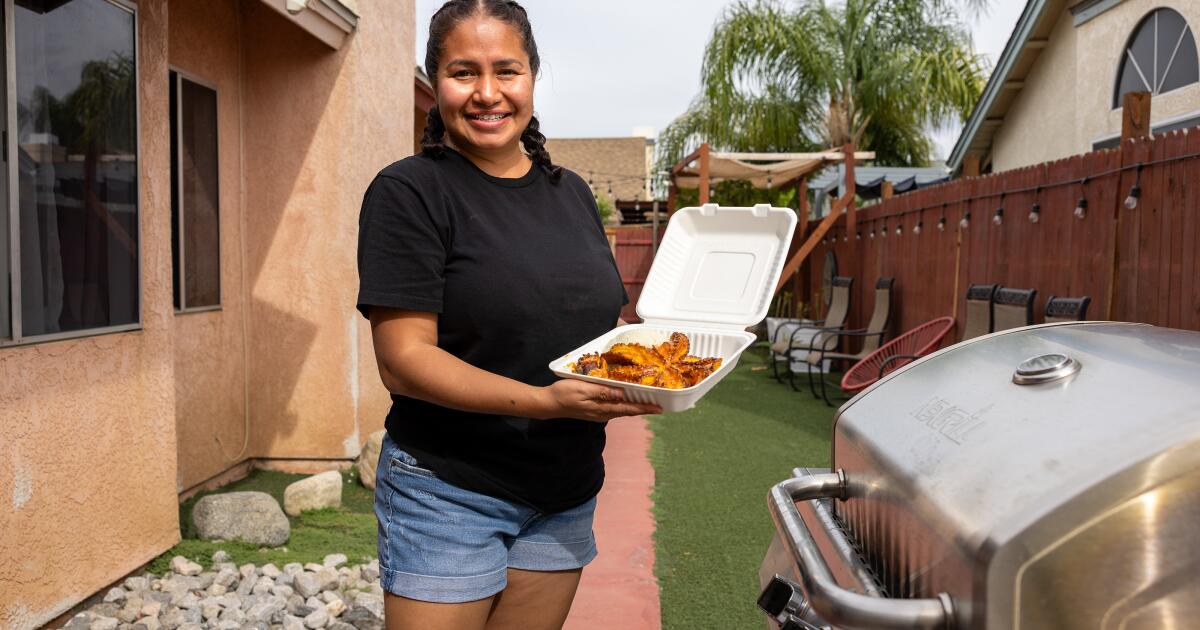
At first glance, the outside of Marcella Guerrero Carrillo’s house is indistinguishable from any of the other single-family homes found in her quiet Perris neighborhood.
The one exception: a small banner planted in her front porch’s flower bed, showcasing a bright-purple octopus intricately laid out on a wooden cutting board, and overlaid with the name “Mariscos El Panzas”— the name of her home-based restaurant, which she’s been running out of her small kitchen for the last four years.
Guerrero Carrillo is among a growing number of Latino entrepreneurs within Riverside County — and across California — who have started a home-based restaurant thanks to a state law enacted six years ago that has carved a pathway for residents to legitimize a practice that has long operated in the shadows.
“I’m very thankful and very comfortable with what I’ve made and accomplished,” Guerrero Carrillo said in Spanish. “Thanks to this, I can be with my children, I’m able to go pick them up [from school], wake them up, drop them off and I am teaching them how to work.”
Her workspace is tightly organized into two sections. One half is reminiscent of a commercial-grade back-of-house, including a secondary seven-foot-long refrigerator used to store the $1,500 worth of seafood she purchases every two weeks.
The other half looks like any other family kitchen.
And just like the outer perimeter of her home, the only immediate difference within the rest of her living area is the three government-issued certificates hanging on the wall right by the doorway.
From Monday to Wednesday, her week is fully dedicated to her children. She takes them to their baile folklórico classes, helps them with their homework and travels to Orange County to visit family.
From Thursday to Sunday, she is on business mode. From the comfort of her living room, Guerrero Carrillo responds to dozens of orders that come in through social media, text messages and phone calls. Then, at around 10 a.m., she prepares the ingredients that go into her traditional Guadalajara-style ceviche, pulpo zarandeado, aguachiles and other Mexican seafood meals. By 2 p.m., she’s finalizing orders, handing out the neatly packaged meals to clients as they arrive at her front door and scheduling times to deliver her food directly to other customers.
In the afternoons, after school, her two children also help out. Her eldest son, 14-year-old Derek Renteria-Guerrero, takes over the packaging and handing off takeout orders to customers while Nezli Renteria-Guerrero, 8, occasionally grabs small items from the garage.
“I feel good that I have a mom that has this kind of job,” Derek said. “I feel like I have more time with her.”
Called the Micro Enterprise Home Kitchen Operations (MEHKO) program, the idea was championed by former Coachella Valley Assemblymember Eduardo Garcia. Introduced as Assembly Bill 626 in 2017, the first section of its text acknowledged that this type of business already existed informally and that legitimizing home-cooking operations would primarily benefit women, immigrants and people of color.
Garcia said that he grew up around immigrant entrepreneurs who built successful, yet under-the-table, businesses throughout his neighborhood: a baker who made the cakes for quinceñeras, a husband and wife selling tamales in a parking lot and a family selling tacos out in their driveway.
It’s a pivotal part of the Latino culture, he said, but also ran the risk of being harmful to the consumer since these businesses couldn’t be evaluated by health inspectors. So when the opportunity came to legitimize these enterprises, he took it.
“This was my barrio legislative agenda,” Garcia said. “We took an issue, a problem, an opportunity, and created legitimacy for thousands and thousands of people to have a path for economic self-determination and ultimately economic empowerment.”
A year later, California’s former Gov. Jerry Brown signed the bill and it went into effect at the start of 2019. The state left the adoption of MEHKOs in the hands of each jurisdiction; however, it would take only five months for Riverside County to become the first to officially adopt the MEHKO program, with four of the five county supervisors voting in favor.
“We knew already that there was a lot of interest in our region, there was a growing cottage food industry already that was underway,” Garcia said. “And I’m not surprised to see how well it’s done right in Riverside County, specifically.”
Supervisor V. Manuel Perez, who represents the Coachella Valley, pushed for its adoption because of its potential to break down the high barrier to entering the food business, especially in a county with a large Latino population.
“Home kitchens have existed for generations in my neighborhood and in many neighborhoods throughout the state of California,” Perez said at the May 2019 Riverside County Board of Supervisors meeting. “It is part of our cultural heritage to open up our homes for meals, as far as myself and where I grew up, being Latino, and having folks sell food out of their homes, including myself.”
The region has since approved 343 MEHKO permits over the last six years, according to Riverside County Environmental Health Supervisor Sandi Salas, with 41 of those applications approved in 2025.
Roya Bagheri, the executive director of, COOK Alliance, a nonprofit that advocates for the MEHKO program, called Riverside County a trailblazer and said that it had set an example that other counties have followed.
According to a report released by the COOK Alliance earlier this year, approximately three-fifths of Californians now live in an area where MEHKOS are legal, with Los Angeles’ recent opt-in last year tipping the scale past the halfway mark.
The report also showcased that 97% of MEHKOs have not received any formal complaint, 28% of micro-enterprise owners are Latino and almost half of all businesses are immigrant-owned.
This also leaves 40% of the state’s residents who cannot legitimately open a home kitchen operation, including neighboring San Bernardino County.
“People who live in San Bernardino are still having to do this under the table and live in fear of getting shut down,” Bagheri said. “It’s difficult to see that and to see people not have a way to legally be able to pursue this type of business.”
Business owners who are not able to receive a home kitchen permit are at constant risk of being shut down by the health department, she said. On the other hand, those with MEHKO permits have access to loan opportunities, tax incentives and small-business educational resources.
The program, she added, has particularly helped monolingual Spanish speakers who use it to earn an income despite being limited by language barriers.
“Especially now with what’s happening to immigrants and the fear amongst the community members, we heard from some MEHKOs who are really able to say that having a permit has been helpful, because they feel safe in their home,” Bagheri said. “They also are able to fill a gap and feed some of their other neighbors, who might be immigrants, who are afraid to go out to restaurants, but are looking for food.”
Guerrero Carrillo said that at the height of immigration raids last summer, many of her customers who previously ordered from home began opting for delivery. More recently, Guerrero Carrillo said she had received now-deleted threats to have U.S. Immigration and Customs Enforcement agents called to her home after an influencer posted a social media video of her business.
“I responded with ‘Call them, it would be nice to serve them here in my home,’” Guerrero Carrillo said. “I don’t think it’s a bad idea for undocumented person to own a MEHKO because they would be working legally.”
For years, after immigrating to the United States in 2006, Guerrero Carrillo sold her meals informally. Nine of those years had been spent working part time at a hardware store, she added, using her off days — and sometimes her vacation hours — to cook on the side.
She learned about the program in late 2020 while scrolling online after being threatened to have the health inspectors called on her, she said. The following spring, she received her permit.
Guerrero Carrillo says that this is the first year she’s decided to fully dedicate herself to her business, finally quitting her hardware store job in March.
Although MEHKOs are seen as a stepping stone into the food industry, Guerrero Carrillo has decided that she would rather focus on feeding her smaller clientele base for now. She plans to continue enjoying her flexible schedule with her children without the added stress that a brick-and-mortar entails.
Instead, she’s added more summertime recipes to her menu and is currently considering a name change so that she can sell more than just seafood. She’s also working on getting the necessary permits to convert her backyard into an eatery.
“I think it is more common in Latin culture to have a business within your own home,” she said. “I would like to open the doors to my house, not completely, but open the doors to my house so people come to eat their food.”
Hernandez is a freelance writer based in Riverside. This article is part of a De Los initiative to expand coverage of the Inland Empire with funding from the Cultivating Inland Empire Latino Opportunity (CIELO) Fund at the Inland Empire Community Foundation.
The post How Riverside County led a wave of Latino home-cook entrepreneurs across the state appeared first on Los Angeles Times.