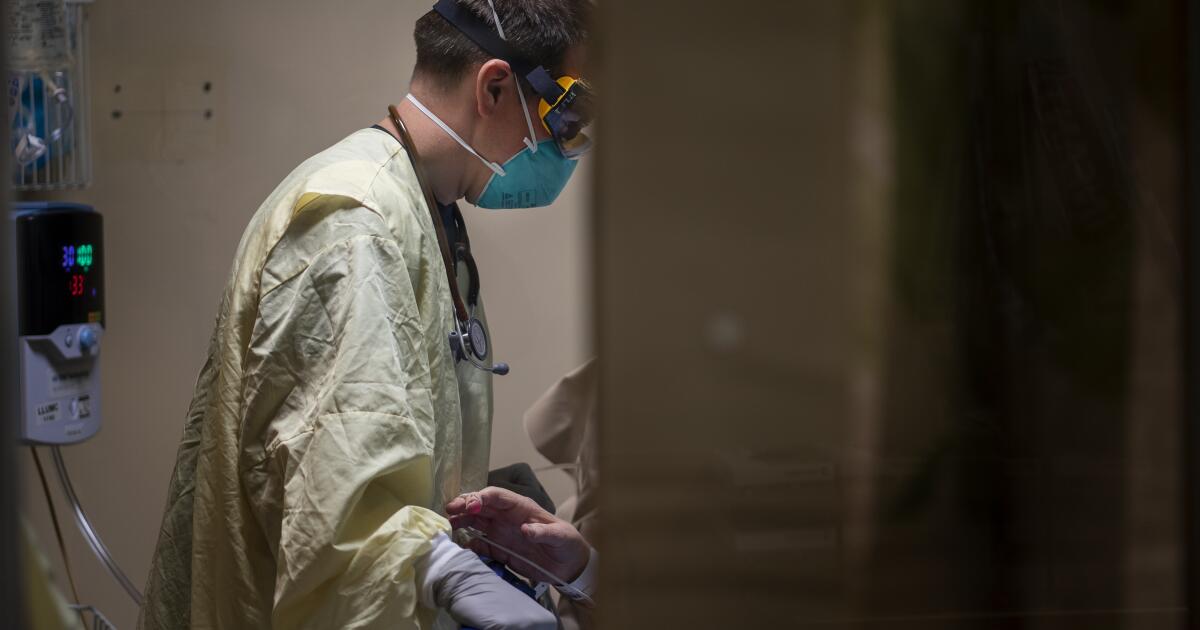
A recent episode of HBO’s “The Pitt” portrayed the chilling effects of immigration enforcement in healthcare. Immigration and Customs Enforcement agents dressed in tactical gear and face coverings brought in a woman in zip ties to the emergency room for medical clearance. Chaos ensued: Staff were confused about how to care for the patient, both staff and patients left the hospital out of fear of being targeted and there were violent confrontations between the ICE agents and staff. Although fiction, the episode illustrated the realities of what has been happening in hospitals across California, where our healthcare, well-being and working conditions are threatened by the presence of ICE.
As resident physicians in the state, we have lived similar stories. In a real-world California hospital, one resident was forced to discharge a patient with poorly controlled diabetes back into ICE custody. Because of the detention center’s medical neglect, the patient’s blood sugar had risen to a level requiring ICU care. He was stabilized in the hospital only to be sent back to the very facility where he fell in danger. When hospitals send patients back to the same conditions of neglect, there is no long-term plan, only a deferment in their next medical crisis.
Medical neglect in immigration detention facilities is widely documented. Patients in ICE centers are often denied adequate food, drinkable water, clean clothing and medications. Their access to medical care is often delayed, when not outright denied. If and when patients in ICE custody are brought to the hospital, the presence of immigration enforcement makes it difficult for these patients to get the care and services they need.
Hospitals bear responsibility for this. Rather than establishing clear policies to protect patients and staff, hospitals have largely complied and cooperated with immigration enforcement. ICE agents have refused to leave the room during private medical interviews, chargedworkers with felony assault after they intervened to protect a patient, forbidden providers from calling patients’ families and legal representation or required that patients use pseudonyms that effectively hide their whereabouts from family. A state law passed last year requires hospitals to protect patient privacy from ICE, yet implementation has been inconsistent across hospitals. When hospitals go along with harmful policies and decisions, they normalize harm.
At one Northern California hospital, resident doctors asking about ICE protocols were told their institution hoped to “fly under the radar of the Trump administration” by acquiescing to ICE demands. Formally, University of California facilities instruct residents to treat ICE detainees as “individuals under law enforcement custody,” despite the fact that immigration detention is civil, not criminal. UC risk management has also instructed resident physicians not to help connect patients to a lawyer, but instead to give “know your rights” fliers and hotline information to patients — who often do not have access to phones.
Hospitals are meant to be sanctuaries that promote healing. Yet, immigration enforcement has infiltrated clinical spaces and degraded trust at the bedside. Trust is not inconsequential in medicine; it is fundamental to whether patients seek care, relay critical information, take medications and even survive their illness. As providers, many of us are unsure whether we are allowed to connect our patients with legal services or even insurance coverage, such as Medicaid. These concerns aren’t unfounded: ICE has camped out at hospitals to apprehend patients and has used access to information within Medicaid records to deport patients. These should be illegal transgressions of patient privacy, but currently, they are not.
As doctors, we have a vantage point that allows us to witness firsthand the harmful and, at times, deadly consequences of immigration enforcement in our clinical spaces. The Hippocratic oath we take demands first and foremost that we do no harm. Yet hospitals are increasingly subordinating this oath to institutional self-interest. This is an immoral path, and as physicians on the front lines of patient care, we refuse to accept it.
Thanks to resident and community advocacy, Los Angeles County implemented a policy this month to protect patients in ICE custody who come into county hospitals. Other hospitals must follow suit. Hospital leadership should stand with staff and patients, not with ICE. All hospitals must articulate clear, standardized protocols for ICE encounters, ensure front-line workers are trained to protect patient privacy and be held accountable when they fall short of the California law meant to shield patients from ICE.
All of us can do our part as well: Residents can organize with our union, CIR/SEIU, or with organizations such as the People’s Care Collective. Community members can contact state representatives to demand enforcement of last year’s Senate Bill 81, report noncompliant hospitals to the California Department of Public Health and the attorney general’s office and support legal organizations such as the Coalition for Humane Immigrant Rights.
Hospitals exist to heal, not to function as arms of immigration enforcement. When hospitals blur that line, they don’t just erode the ethical mandates of medicine: They choose complicity and harm over care. Hospitals should choose courage instead and join healthcare providers in honoring our oath — to stand with patients, not ICE.
Alana Slavin is a psychiatry fellow in Los Angeles. Marina Martinez is an internal medicine resident physician in San Francisco, where Sascha Bercovitch is a psychiatry resident physician.
The post An emergency room is no place for immigration enforcement appeared first on Los Angeles Times.