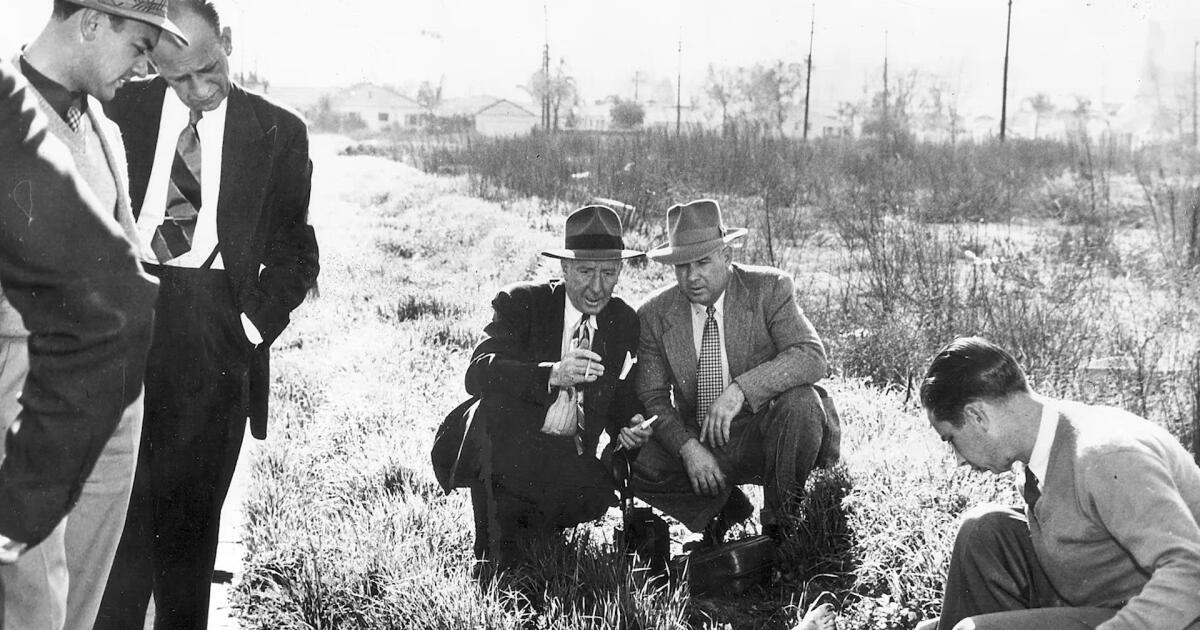

The woman known as the Black Dahlia had not been dead long before the smears began. Two months after her mutilated, bisected body was found in a South Los Angeles lot on Jan. 15, 1947, a newspaper headline asked: “‘Dahlia’ to Blame?”
Looming over the case was the suspicion that Elizabeth Short, who was jobless and homeless when she died at 22, might have somehow provoked her own gruesome fate. She was a “tease,” lead detective Harry Hansen declared, which probably “set some guy off into a blind, berserk rage.”
Jack Webb called her “lazy” and “irresponsible” in his popular 1958 account of the case. She was “already obsolescent” when she died, he wrote — an unmarried woman who opted instead for an “easy loving” lifestyle.
“Right from the beginning, people were blaming her for her own death,” said historian William J. Mann, whose recent addition to the voluminous case literature is “Black Dahlia: Murder, Monsters, and Madness in Midcentury Hollywood.”
After her death, which remains one of the most stubborn unsolved mysteries in the annals of L.A. crime, Short acquired the persona of a femme fatale. The process was abetted by the catchy postmortem moniker — a nod to her jet-black hair and dark clothes.
“For too long, she’s been mythologized into this dark, slinky, seductive, wicked character,” Mann said, while in reality almost all her encounters with men were nonsexual.
“[Like] she’s some kind of vampire. When in fact she was just a young woman with agency and curiosity and wanted to see the world,” he added.
A Massachusetts-born child of the Great Depression, Short came to Southern California not to find film stardom — another myth — but to pursue a doomed relationship with a man. Adrift in Hollywood, she was known to fabricate pitiful stories to win a meal or a place to sleep.
“Men are applauded when they go off on their own and live by their wits and con people sometimes to get something to eat,” Mann told The Times. “They’re Tom Sawyer, Huckleberry Finn. But Elizabeth does it, women do it, and they’re seen as somehow decadent or immoral.”
Mann said he wrote the book to restore Short to “the fullness of her humanity.” He also lays out a case for who might have killed her — the same suspect, Marvin Margolis, put forward recently by the cold-case consultant Alex Baber, with the endorsement of two former LAPD detectives.
Margolis was a psychologically disturbed World War II veteran and USC student who had lived with Short briefly at the Guardian Arms Apartments in Hollywood.
He had been a Navy corpsman at the horrific battle of Okinawa. There, one of his duties was to retrieve detached limbs.
“He was this gofer,” Mann said. “He was this errand boy, picking up dead body parts. He was allowed to participate as an assistant in some of the surgical procedures, but he was never allowed any great responsibility.”
The neat division of Short’s body — separated efficiently between the second and third lumbar vertebrae — seemed to reflect “medical finesse,” Det. Hansen thought, and the investigation has long been governed by the search for a surgeon. Margolis was embittered by his failure to become one, according to a military psychiatrist who interviewed him.
“He was in the operating room,” Mann said. “He would’ve seen bodies pulled apart, he would’ve seen where the internal organs were. He was charged with trying to put bodies back together that had been blown apart.”
Soon before her death, Short got involved in a romance with Mark Hansen, a wealthy club owner, which might have reminded Margolis, then 21, of his comparatively low power and status.
“The only way to understand what was done to Elizabeth Short’s body is to consider the fact that the perpetrator was fueled with a rage at society, at women, perhaps at his own lack of achievements,” Mann said. The killer was “basically giving the middle finger to the world, saying like, ‘OK, you guys never gave me anything in this life.’”
The Leimert Park neighborhood where the killer dumped Short’s body was not an isolated one. Young families lived there, and veterans adjusting to peacetime.
Perhaps “he’s looking around [at] all these people and saying, ‘Screw you all with your perfect lives,’” Mann said. “I’m gonna leave this body right here so you can all see it, and you can see how I feel.’ And also: ‘Look what I was able to do. Those bastards in the Army never gave me a chance to prove what I could do on the operating table here. Look at my surgery.’”
At the time of Short’s death, Margolis was a premed student at USC, and Mann speculates he may have mutilated her in the campus cadaver lab during a week when not many people were around. He added, “I don’t have any hard proof of this.”
On the specifics of where Short died, Mann differs sharply from Baber, the amateur sleuth who says Margolis was not just the Black Dahlia killer but the Zodiac killer who terrorized the Bay Area in the late 1960s and early 1970s.
According to Baber, Margolis, who died in 1993, left a network of clues linking himself to both cases. Baber says he found one of Margolis’ aliases in a Zodiac cipher, and that Margolis’ deathbed drawing of a topless woman entitled “Elizabeth” contains the word “Zodiac” in the shading.
Baber believes that Margolis bisected Short at a Compton bungalow motel called the Zodiac, and that the motel inspired the moniker he would use two decades later in letters to police and the media.
“One of the things we have to be careful about is confirmation bias,” Mann countered. “So if you already think that your killer is also the Zodiac killer, and then you find, ‘Oh look, here’s the Zodiac Hotel,’ you know, that’s confirmation bias and that’s something we have to be careful about.”
Baber is not the first to suggest a link between the Dahlia and Zodiac murders, but his theory has generated widespread attention in recent months. On the surface, the two unsolved cases — separated by more than 20 years and hundreds of miles — bear little resemblance.
The Zodiac claimed to be responsible for 37 murders, but only five are officially attributed to him. In December 1968, he fatally shot two high school students parked on a lovers’ lane in Solano County in the Bay Area.
The following July, also in Solano, he shot and killed a 22-year-old woman who was sitting in a parked car, then called police from a pay phone to take credit.
He sent letters and cryptograms to Bay Area newspapers, threatening to kill random people if his work was not printed. A Salinas couple cracked the first cipher.
“I like killing people because it is so much fun,” it read. “It is more fun than killing wild game in the forest because man is the most dangerous animal of all to kill …”
Killing was “the most thrilling experience,” the Zodiac wrote, “even better than getting your rocks off with a girl.” He added that his murders were about the “collecting of slaves for my afterlife.”
In September 1969, the Zodiac stabbed to death a 22-year-old Pacific Union College student who was picnicking with a friend at Lake Berryessa. The next month, he fatally shot a 29-year-old cab driver in San Francisco and sent a piece of the victim’s bloody shirt to the San Francisco Chronicle along with a letter taking credit.
He threatened to shoot out the tires on a school bus and murder children as they emerged, which induced terror in the Bay Area and prompted police to escort buses.
Julia Cowley, a former FBI profiler who now hosts a podcast called “The Consult” in which she and other profilers examine criminal cases, says the differences between Short’s murder and the Zodiac crimes are profound.
She said the Short case was “an intensely personal, hands-on type of crime” reflecting sexual sadism. “The body itself is the focus,” she said, “not the public, not the police, not the media … the primary source of gratification was the time he spent with her body mutilating her.”
The Zodiac killings, on the other hand, seemed impersonal and media-focused. The killer attacked quickly and escaped, leaving some of his victims wounded but alive.
“It kind of shows you that maybe the victim themselves are not that important” to him, Cowley said. Instead, it was about public recognition.
“He demanded publication, he corrected the police. When they didn’t get it right, he kept score,” she said. “He used the media as a way to torture and instill fear in the public.”
She emphasized that profiling is not a hard science, but said that behaviorally, she cannot link the cases.
“But I hope that forensic evidence does, and these cases can be finally closed for good,” she told The Times.
The LAPD, which has the Dahlia case, and the San Francisco Police Department, which has the Zodiac case, have been tight-lipped about what, if anything, they are doing to investigate a possible connection.
Mitzi Roberts, a former LAPD cold-case detective who endorses Baber’s theory, said her old department has an investigator on the Dahlia case but that the San Francisco cops have more physical evidence to work with.
“It feels like the two agencies, the Bay Area and L.A., are waiting to see what the other one does,” Roberts said.
The post Dahlia killer was sadistic, Zodiac sought publicity: Experts cast doubts on link appeared first on Los Angeles Times.