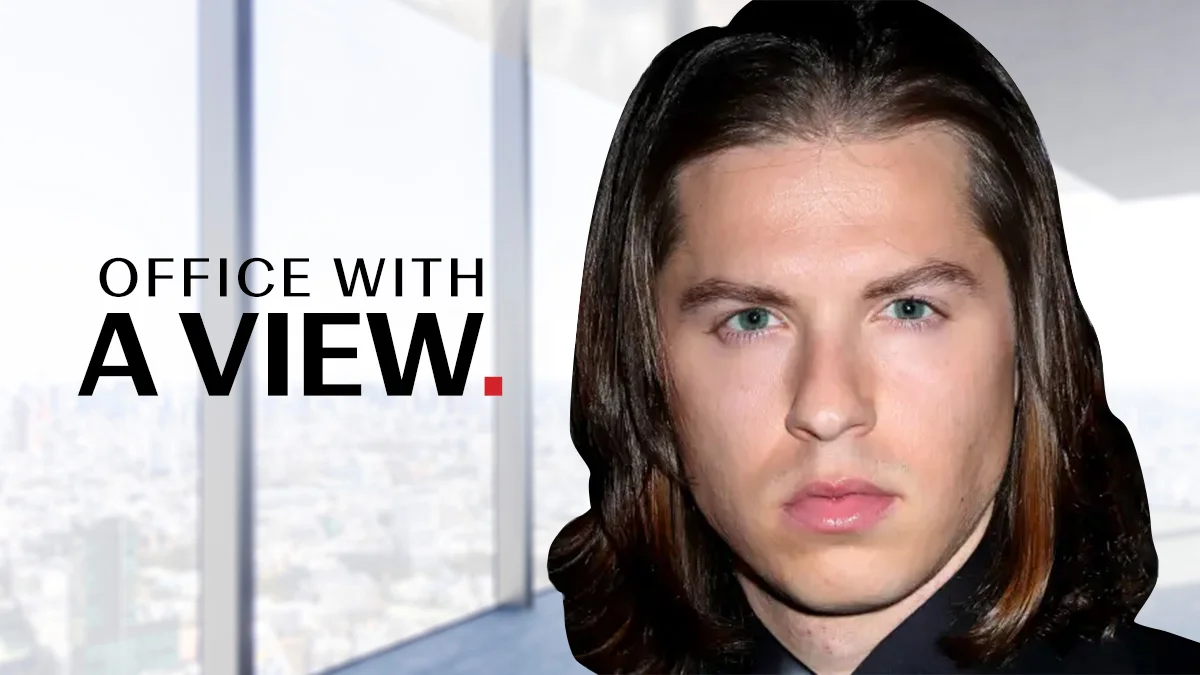
Peter Gold’s debut as a film distributor hit a $33,138 per-theater average when “Our Hero Balthazar” opened March 27 on one screen at the Regal Union Square in New York — enough to top the specialty box office in its first week.
The 26-year-old co-founder of WG Pictures nabbed the highest per-theater average in the country with zero paid advertising, instead tapping the combined 40 million social media followers of his cast, a viral Caleb Simpson video (the social media influencer known for his viral apartment tour videos) that racked up 15 million views and a willingness to blur the line between marketing and content.
“Our Hero Balthazar,” a black comedy starring Jaden Martell, Asa Butterfield and Noah Centineo, follows a wealthy New York City teen who, eager to impress his activist crush, follows an online connection to Texas where he believes he can stop an act of extreme violence.
The film is now expanding to 300 screens nationwide, adding theaters including New York’s Angelika and locations in Cleveland as the film continues to attract attention on social media and through local influencer events in each city.
Gold spoke with The Wrap, alongside his business partner, veteran producer Brad Wyman, about why he believes traditional advertising “hurts the overall brand,” how a character Instagram account with 44,000 followers drove a conversation about the film and why A24 and Neon’s growth has created an opening for a new boutique player.
You started making films at 15 and got mentored by Esther Wojcicki and James Franco. How did those early relationships shape what you’re doing now with WG Pictures?
Gold: I think it’s about self-starting and going for it. In Esther’s journalism class, it was all student-led. She was more of an observer and kind of mastermind of the whole thing, and she set it up so students could learn by doing. Her journalism class was taught like a real publication. People were operating it like it was a real student newspaper.
The film program that Esther also started was the same way. We just made a movie, and we figured out how to get the locations, all the things that go into making a movie. She pushed us to just go and make it. Having that experience early on of being a self-starter, if you see something and you see an opportunity in the marketplace, or you’re driven to make a difference in the world and make a difference in the film industry, just go and do it. That’s what we’re doing here. Those principles were kind of put in me very early.
Most distributors passed on “Our Hero Balthazar.” What did you see in the movie that they didn’t?
Gold: Brad and I saw something incredibly exciting. We just love the movie so much. It’s not about comparing it to anything else. It’s just so exciting. It’s an incredible ride. It’s exciting, it’s thrilling, it’s dark, it really touches on some very important topics, and it’s one of the most provoking films of the year. Exciting rides like this are really hard to come by.
I was baffled that people weren’t all over this. But I guess the general consensus is because the subject matter is scary for an existing distributor to take on such a controversy. For us, that was exciting.
You hit a $33,000 per-theater average on your opening weekend with zero paid media, just organic social. Was that a constraint or a choice?
Gold: We’re starting to do paid media now because we’re preparing for an expansion. I think when you do a paid ad, there’s essentially a button for ticket sales. But to be honest, I’m not really sure it’s necessary. The cost per click isn’t that exciting.
When you have someone like Caleb Simpson who generated, I think we’re almost at 15 million views, it’s one of his highest performing videos ever, and all of his videos get millions. But I think this one just really stood out to people because it was the first time you saw someone on his feed that actually wasn’t a real person. He’s always interviewing people that are real. He goes into their house and he does apartment tours, and they’re always very fascinating. Scarlett Johansson, all sorts of celebrities, and also just people that he meets on the street.
But in this case, it was Jaden Martell, who’s not necessarily that widely known, but most people saw it as rather confused. Is this a character or is this a real person? It helped to really drive a lot of conversation around the film and promote ticket sales as well.
In terms of whether it was a constraint or not, sure, we don’t have the budget for P&A and marketing that our competitors have right now. But we also don’t really believe that we should put a lot of money into paid media. We’re used to seeing ads so much on our feed that we just kind of scroll through. When you see a post coming from Noah Centineo or Halsey or Caleb Simpson, that will make you lean in and watch the whole video and then say, “Oh, what is this about?” Start to ask questions. When we dumb it down with a paid ad, I feel like we’re really just hurting the overall brand.
Your partner Brad is 60 and you’re 26. Why that partnership? What does he bring that you don’t?
Gold: Brad has 50-plus movies of experience. He has incredible taste in movies. He fell in love with this movie the same way I did, and we just have so much shared synergy in terms of what we see for movies in the future. We both want to see movies in the theaters. We believe in the theatrical release, and we’re both excited by taking exciting, more daring movies to the big screen and giving them the marketing they deserve.
There’s just a lot of synergy. Quite frankly, we have a lot of laughs together, and it’s fun to work together. It doesn’t feel like working when we’re doing this.
Wyman: Let me just say very quickly that when people see the two of us, they kind of think Peter’s the adult in the relationship. What we share is just a true passion for motion pictures and a love for them, and it’s very honest and very real. That’s what we’re trying to promote.
Your first film hits number one in specialty box office on one screen. What’s next for WG Pictures? Are you staying boutique or scaling?
Gold: We’re expanding “Balthazar” to 300 screens across the country. We just added Angelika in New York, Cleveland, and more screens are being added all the time as the film continues to attract attention on social media and through local influencer events in each city.
What’s next after that is “Toad.” This is Brad Wyman’s passion project. For many years, he’s been producing this movie. It stars Kat Williams as a talking toad, along with Ike Barinholtz, James Franco, Tiffany Haddish, Craig Robinson, Bobby Lee and Howie Mandel. It’s an all-star cast with a lot of support from the cast.
What’s important about a movie is that when you do have cast with big followings, whether it’s movie star status or not, if they don’t love the movie that they’re working on, they’re not going to come out and promote it the same way. They’re not going to use their platforms to really stand behind the movie. That’s one of the main focuses. With “Balthazar,” we had that because it was a passion project, and it comes from that same authentic place. “Toad,” although this is more of a crowd pleaser, is a popcorn movie made to make people laugh.
Wyman: We’re aiming for an Aug. 28 release in about 1,000 cinemas. It depends what the picture warrants. Sometimes you just need to start small and grow big. And then sometimes you have a silly thing you can put just all across the nation. “Toad” really wants to uplift everyone, make everyone laugh, give everyone a really good time in the theater. Something I think we can all use.
We love our colleagues and competitors, Neon and A24. But in some ways, they’ve grown too big for the space. They’re doing $200 million Dwayne Johnson movies and $150 million Timothée Chalamet movies. Right now, we’re trying to tell really unique, original stories.
The post How Peter Gold’s WG Pictures Hit a $33K Per-Screen Average Without Spending a Dollar on Ads appeared first on TheWrap.