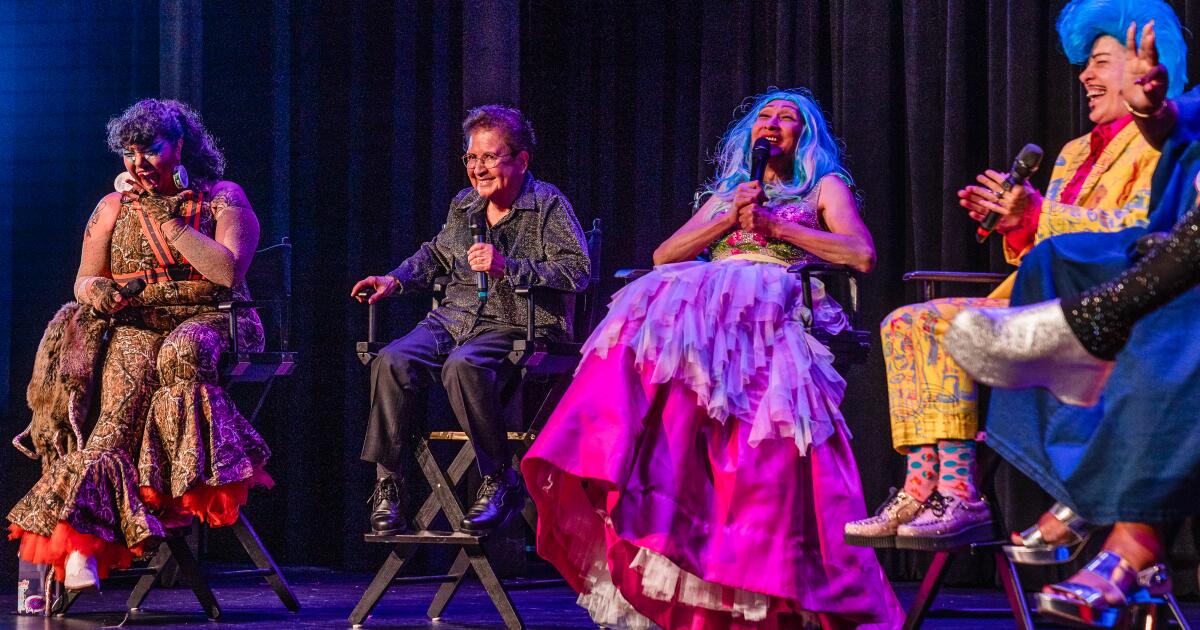
Backstage at the Barnsdall Gallery Theatre in East Hollywood, drag kings and queens bustled inside the dressing room, making their transformations into glittering stars ahead of an April 22 revue titled “Living Legends of Drag: Stories of LGBTQ+ Artistry & Culture.”
“Five minutes to showtime,” said Lil Miss Hot Mess, drag queen and hostess, as Latine drag kings El Daña and Manny Oakley readied themselves for the spotlight.
Elsie Saldaña — who goes by El Daña onstage — prays before every show she has performed since 1965. That day, El Daña said she was grateful to be sharing the stage with iconic legends of drag in Los Angeles.
But no matter how long it has been, El Daña and Oakley both agreed: the nerves never go away.
“I’m 81. I hope my knees don’t [give] up,” said El Daña, clad in black from head to toe. Last year, she was recognized as the world’s oldest performing drag king by the Guinness World Records.
“I’m 31 and I’m also afraid of my knees,” said Oakley, right on cue.
For drag kings, who are usually assigned female at birth but play masculine characters, the art form is more than just a performance; it’s how they defy gender and cultural norms. Once El Daña and Oakley step on stage for the show, drag allows them to be their freest selves.
“[Drag] is my escape,” said El Daña, a Mexican American daughter of farmers, who is now based in the city of Clovis, Calif. “When I’m onstage, I forget everything else. I feel I’m a star and I kill it every time.”
In a world where mainstream audiences seem more captivated by the glitz and glam of drag queens — take, for instance, the enduring popularity of the reality TV show “RuPaul’s Drag Race” — as a more masculine performer, El Daña has often felt pushed to the sidelines. Within the queer performance scene, she said, drag kings have often received little recognition, fewer opportunities and less monetary gain despite contributing greatly to the art form and the LGBTQ+ community.
But after years of hard work as a trailblazing “male impersonator,” and a decade-long hiatus due to financial problems, the California king of drag kings feels like she is finally getting her flowers.
In 2024, El Daña received the Harvey Milk Community Leader Award for bringing visibility to the LGBTQ+ community of the Central Valley. She co-founded the Sequoia Empire Court of Visalia and Tulare, a chapter of the Imperial Court System. Founded in the Bay Area in 1965, the organization hosts drag pageants to raise funds for the LGBTQ+ community, namely to help those contending with HIV/AIDS and homelessness.
At the height of the AIDS crisis in the 1980s, the organization raised thousands of dollars for this cause through drag shows, where El Daña competed and won the emperor’s title three times.
“A lot of my friends died. And at that time, I gave a lot. I gave a lot of my personal time, every penny I had,” said El Daña, who worked a manufacturing job during the day to support her drag career at the time.
After closing the show with her lip-synced performance of “It’s Not Unusual,” by the lady-loving singer Tom Jones, El Daña received a standing ovation.
That night, it seemed as though El Daña’s decades of fostering pride and unity within the LGBTQ+ community were finally recognized — not only by the queer rights organizations that hosted the event, such as the One Institute and the California LGBT Arts Alliance — but by a younger generation of drag kings, like Oakley.
“To the new kings, the young generation, I wish them the best,” El Daña said. “If anyone comes along and is trying to push you aside, don’t allow it. Just be strong and be in the center stage and rule it. Be kind to everyone. Be gentle and help one another.”
At the show, Oakley graced the stage with her flamboyant charisma and energetic dance moves during her performance of “Chicken Fried” by Zac Brown Band. The Western-inspired drag king felt compelled to perform country songs after living in Tennessee for six years.
“A lot of people really respond to my drag, specifically because I am a Latino doing country drag. Other people of color felt very similar to me, [in] that they [felt like they] weren’t allowed to like country. After seeing my drag, [they’re] given a space to enjoy it,” said Oakley, the daughter of Cuban immigrants.
For Oakley, being a drag king is about challenging masculinity rather than impersonating someone, which is what older male impersonators have traditionally done.
With her bold blue eye shadow and painted black mustache, Oakley wants to not only pay homage to the Black trans queens who brought her to the drag scene in 2018, but also confront gender norms within the drag community.
“It used to be very set in stone,” Oakley said. “Now a lot of people want self-expression out of drag. They want to portray their own artistic talent through drag, rather than just emulating someone.”
Her work goes beyond the stage. As an American Library Assn. accredited librarian, Oakley founded the LA Drag Archive, a physical and digital collection of drag and gender-variant performances, to honor and preserve the legacy of the art form. Oakley believes that recording history empowers her community.
“It’s so easy for the opposition to say, ‘Well, this is just a new fad. Trans people are just coming out of nowhere. This never existed before.’ We have so much recorded history of trans people living from the dawn of time. We can point to that recorded history and say, ‘No, that’s not true,’” Oakley said.
During one of her conversations with “Mama Daña” before the show, Oakley assured the elder icon that her contributions to the LGBTQ+ community are “not lost and forgotten.”
“We would not have gotten out of the AIDS crisis if it were not for lesbians like you who really were there, laying down the groundwork, fighting that bastard Reagan,” Oakley said.
Younger drag kings like her are able to look up to and learn from El Daña because her work was properly recorded, she added.
With her archive, Oakley wants to document drag performers, especially as the art form faces scrutiny under the Trump administration and censorship on social media platforms. In that way, she hopes to inspire the next generation of drag kings to keep dancing through hard times.
The post How these Latine drag kings took center stage appeared first on Los Angeles Times.