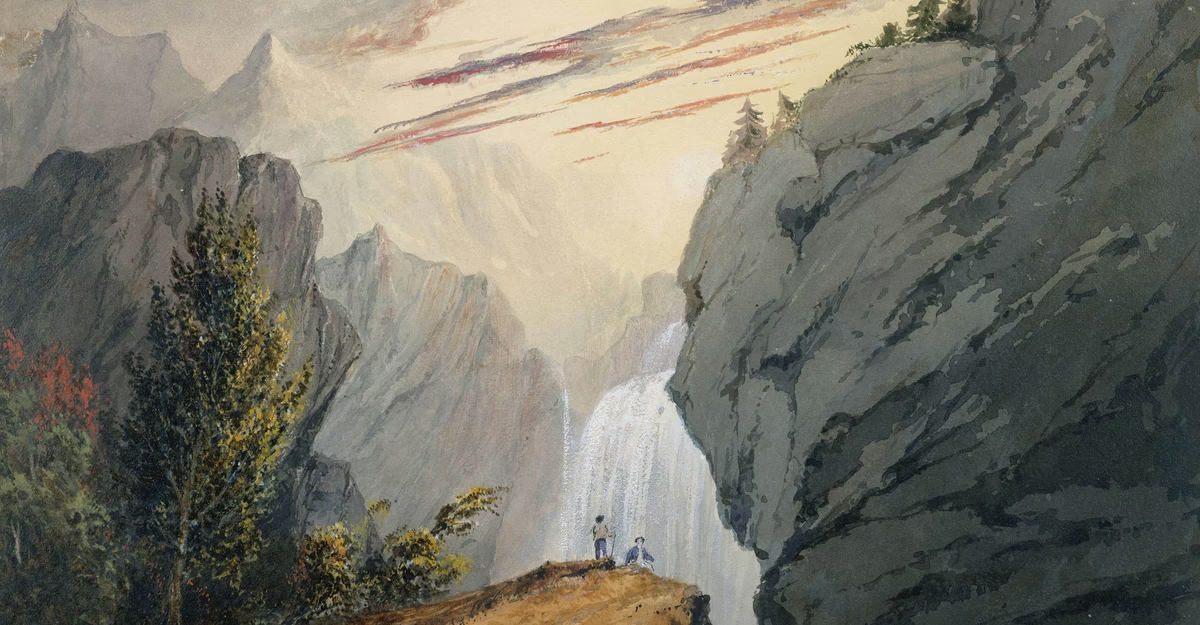
When you stand at the summit of Mount Everest, the sky is a deep-blue bowl inverted above you, and the peaks of the Himalayas are a carpet at your feet. The sun on the snow is bright enough to blind you, even as your body starts failing in air so thin it can hardly sustain human life. I know that not because I’ve been there myself, but because I’ve read Jon Krakauer’s Into Thin Air and other books about the world’s highest mountain.
Krakauer survived a deadly ordeal on Everest—a high price to pay for a remarkable book. But thanks to the alchemy of his crisp, vivid writing, Into Thin Air genuinely manages to conjure the experience for readers, even those who might never trek there. The shine of this magic trick hasn’t worn off, and my favorite place to encounter it is in a truly harrowing adventure story. Life-and-death stakes? Dangerous mysteries? Motley crews pitting themselves against impossible odds? Sign me up—but only vicariously, please. I like my adventures paired with a cup of tea and my softest blanket.
Many readers, even the ones like me, are drawn to epics of disaster and survival, accounts of cross-country marathons and exceptional journeys to far reaches—transportive stories about ordinary people attempting extraordinary things. Here are seven books that I promise will spirit you to some of the planet’s wildest landscapes and greatest human feats, even when read in total comfort.
Endurance, by Alfred Lansing
I’ve read a lot of books about the suffering endured by the 19th- and early-20th-century European explorers who, seeking to reach the North and South Poles, slogged and starved and (sometimes) cannibalized their way through enormous fields of ice. So I feel well qualified to say: If you read only one book about a frozen expedition gone awry, make it Endurance, Lansing’s propulsive, compact, and rigorously researched narrative of Ernest Shackleton’s remarkable 1914 Imperial Trans-Antarctic Expedition. Shackleton and his crew had intended to make the first complete traversal of Antarctica. But their ship, the Endurance, became trapped in sea ice before they even made it to the coast, kicking off a many-month struggle to survive—first on board their doomed vessel, and then adrift on a series of ice floes after it was crushed. Lansing, an American journalist, interviewed several of the remaining survivors in the 1950s and consulted diaries and other documents. Every carefully chosen detail brings the icebound sailors’ plight to creaking, finger-blackening, stomach-growling life, and the result is riveting.
[Read: The power of fear in the thawing Arctic]
A Walk in the Park, by Kevin Fedarko
Fedarko’s title is, presumably, a nod to A Walk in the Woods, Bill Bryson’s well-known memoir of hiking the Appalachian Trail, and the author initially takes a similarly bumbling and underprepared approach to his own long walk: With a photographer joining him, he’s hoping to hike the entire length of the Grand Canyon, piecing together a barely there path between the rim and the river. But the risks in the Southwest’s canyon country are greater than those of a New England summer. Fedarko, a former Colorado River raft guide, must enlist a fascinating array of veteran local hikers and slot canyoneers to help see his party through potentially fatal hazards: navigational challenges, extreme heat, scarce and unpredictable water sources, and gravelly cliff faces. This massive undertaking seems, at times, like a fool’s errand. But as Fedarko proceeds, his deep familiarity with, and love for, the region comes through strongly, and his vivid writing makes even the most miserable points of the journey sound at least a little bit tempting.
[Read: How to survive running across the Grand Canyon]
Coasting, by Jonathan Raban
In Coasting, Raban chronicles his solo journey, in a sailboat, around the island of Great Britain. “Home is always the hardest place to get into sharp focus,” he writes; so, in his 40s, he hopes that floating just offshore will give him a clearer perspective on the nation that raised him. England seen from the water is “a gloomy house, its shutters drawn, its eaves dripping”—but it’s not the only character in Raban’s narrative. The ocean itself becomes a companion, as do the treacherous coast and the many people Raban meets on land along the way. Coasting is partly a lovely work of nature writing, partly one Englishman’s uneasy memoir, and perhaps most of all a caustic, granular portrait of the Thatcher years. At one point, he arrives in port to learn that war has broken out in the Falkland Islands; the grotesque absurdity and jingoism surrounding that conflict are a target of his acid observations for the rest of the voyage. As Colin Thubron wrote about Coasting in The Times of London 40 years ago: “The poetry is in the pitilessness.”
A Hope Divided, by Alyssa Cole
Cole’s suspenseful, sexy novel is both a historical romance and a breathtaking story of two people running for their lives. During the American Civil War, Marlie, the daughter of a formerly enslaved Black woman and an affluent white man, is part of a network of Black Americans who spy on, undermine, and resist the Confederacy from within the South. She uses the relative freedom conferred by her father’s family to do what she can for the Union, including sheltering a white Union soldier, Ewan McCall, who’s escaped a prisoner-of-war camp. Soon, Marlie and Ewan are forced to flee together. Hunted by a sadistic Confederate officer, knowing that capture will mean torture and death, they follow the Underground Railroad through the Carolina wilds. They have to choose whom to trust, both in white communities and among the hidden pockets of escaped Black people who help them on their way; most of all, they have to figure out who they are to each other. Cole’s novel is based on the real, little-known history of Black resistance to the Confederacy, and it’s also a gripping adventure.
In the Heart of the Sea, by Nathaniel Philbrick
In 1820, an American whaling ship was attacked by a whale—an incident that became so infamous, it helped inspire Herman Melville’s Moby-Dick. In the Heart of the Sea is Philbrick’s National Book Award–winning nonfiction narrative about that disaster and the crew’s fight to get home. Whereas Lansing’s treatment of Shackleton’s Antarctic survival epic is stirring, Philbrick’s tale of the Essex is more like a horror story. First, the men are menaced by an enormous, enraged sperm whale (terrifying, even as on some level the reader can’t help rooting for it against the harpoons), which rams and ultimately sinks their boat. The survivors, drifting on the open ocean, are then whittled down by hunger and thirst, by the varied dangers of the Pacific, and eventually by one another. This is survival rendered in its rawest, ugliest, most gut-churning form.
The Sun is a Compass, by Caroline Van Hemert
Some of the most extreme adventures described in the books on this list were not matters of choice; their protagonists were forced into do-or-die journeys by circumstance or bad luck. Not so for the Alaskan wildlife biologist Caroline Van Hemert, who, disillusioned with laboratory life, attempted to regain her love for her field via a daring and physically demanding journey from coastal Washington to the Arctic. Van Hemert and her husband traveled 4,000 miles under their own power—first in homemade rowboats through the damp, rocky gantlet of the Inside Passage, which connects the Pacific Northwest to the Gulf of Alaska, and then via a combination of ski mountaineering, canoeing, hiking, and rafting across the interior of the Yukon and Alaska. Meaningfully, Van Hemert chose a route that follows the northward migrations of birds, the creatures that first sparked her love of science and the wilderness. Her time in the wild is dangerous and demanding, but it restores something important within her—and her book might also leave readers changed.
The Lost City of Z, by David Grann
Percy Fawcett, the main character of Grann’s story of obsession, was a British explorer who vanished mysteriously with his son in 1925, while on the hunt for a mythical Amazonian city. As Grann starts to painstakingly reconstruct Fawcett’s voyages on the page, the longtime New Yorker staff writer also gets caught up in Fawcett’s mania. He travels to South America himself, looking for clues about the mystery of both the city and its seekers. As a result, the book chronicles two parallel preoccupations, linked across a century: the subject’s and the author’s. Grann doesn’t find everything he’s looking for, but he discovers new evidence about what might have happened to Fawcett—and his book uncovers why this supposedly missing civilization was so ruinously compelling to the men searching for it.
[Read: The painstaking journey to a David Grann book]
The post Seven Books That Will Take You on an Adventure appeared first on The Atlantic.