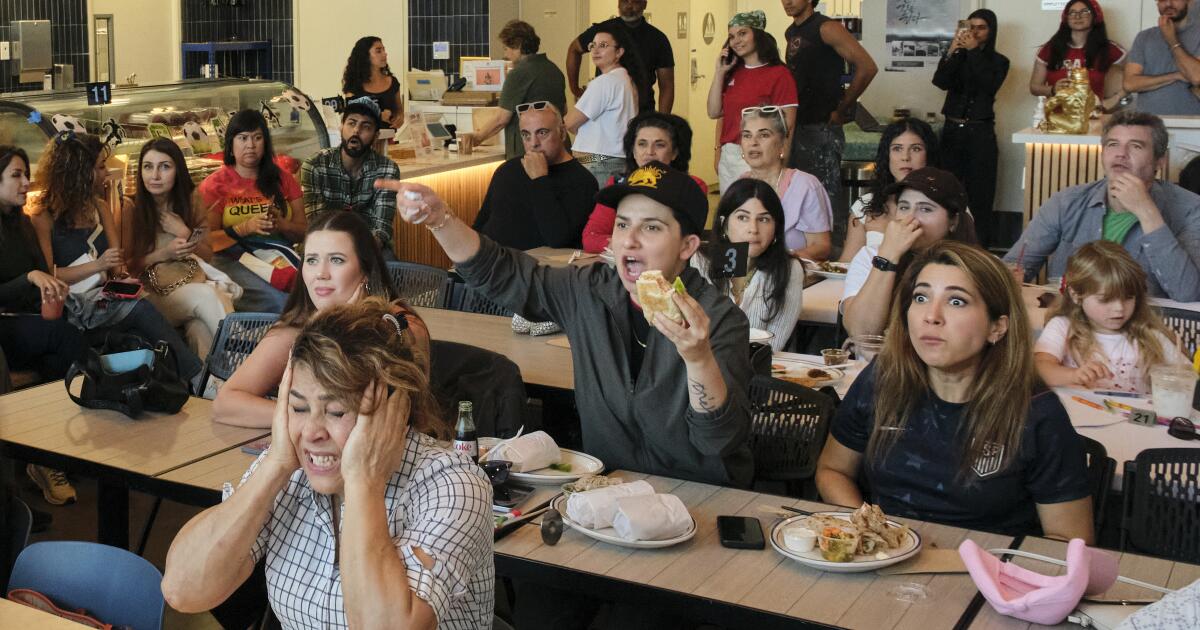
At Meymuni Cafe, nestled in the West Los Angeles corridor anchoring the city’s vast Iranian diaspora, cheers broke out about 35 minutes into Iran’s 2026 World Cup game against New Zealand on Monday evening.
Iran had scored its first goal and amid whoops of joy, Parvin, 76, who declined to provide her last name, wiped tears from her cheeks. She watched intently perched on a bench at the very front of the room, at times shrieking and nudging her sister as she pointed at the cafe’s new large flat-screen that loomed overhead.
She said her faded white T-shirt was more than 50 years old, purchased when she attended the 1974 Asian Games in Tehran, which was one of the last times Iran was able to host an international soccer tournament.
“I was young then and would just meet boys and drink,” Parvin said. “This game is more important. That’s my country, it’s my motherland. I want the children of my country to be happy.”
Her own sister, by contrast, supported New Zealand, because she said she feels Iran’s team and its players “belong to the government.”
The highly charged game at SoFi Stadium in Inglewood set against the backdrop of a months-long war with Iran launched by the U.S. and Israel in February drew strong attendance of L.A. Iranians within the stadium as well as at protests outside. Los Angeles is home to the largest population Iranians outside of Iran.
Dozens had settled into seats at the cafe, newly arranged in rows for the watch party. They slurped the cafe’s signature lavashak smoothie — a tart mixture including peaches, various berries and pomegranate molasses — and munched on slow-cooked lamb over nachos with melty Armenian string cheese.
Meymuni Cafe’s owner and staff said they wanted to provide a space where L.A. Iranians could gather, and sought to keep it somewhat politically neutral. Some in the diaspora are fearful of being openly associated with one side or another of a bitter divide over the U.S.’s military action.
But tension was inevitable, with some L.A. Iranians protesting at SoFi Stadium or avoiding the game altogether. Some view the team as interchangeable with the government they fled from. Others see the team and its success on the global stage as representative of the Iranian people’s resilience.
In the packed stadium, the energy was electric, with fans across political divides cheering on Team Melli. Some arguments and other altercations broke out in the stands as well as outside the stadium, according to footage posted on social media. A group of fans in the stadium booed and turned their backs during the national anthem, waving U.S. and Israeli flags, as well as Iran’s pre-1979 revolution flag emblazoned with a lion and a rising sun despite FIFA’s ban. Some Palestinian flags fluttered in the crowd.
At the cafe, some draped the flag over their shoulders or sported pins, hats or shirts with the lion and sun emblem that is associated with the campaign to return to a monarchy and install Reza Pahlavi, the exiled former crown prince and son of the late shah, as Iran’s leader.
A handful of attendees at the cafe watch party broke into cheers when New Zealand first scored. When Iran scored, an employee jumping and clapping behind the counter led a chant in Farsi of “long live the Shah.”
Laila Emamjoneh, 24, who sat beside her sister and brother-in-law, was startled at the outburst for New Zealand among a group of mostly Iranians. She is half Iranian and half Mexican, and said she had barely followed either teams but wanted to be around her people for this game.
“It’s obviously very intense with everything going on, but I still wanted to be around Persian people,” Emamjoneh said.
Her dad often voices his sadness at the plight of Iranian people back home, she said.
The cafe is typically closed Monday, but owner Shaheen Ferdowsi decided to keep it open for the game, even as other Iranian-owned businesses rejected the idea.
He left the watch party in the hands of his employees, since his mother had managed to snag tickets to the actual game for their family. Ferdowsi said he was excited to be surrounded by thousands rooting for the Iran team.
“Anywhere there’s a lot of Iranians there’s going to be chaos,” he said.
After the game, he said he and his family had been “ecstatic all night.”
Sarah Irani, 48, who wore tri-color green, red and white ribbons in her hair, said the cafe offered a unique space that differed from some older businesses in Westwood, nicknamed Tehrangeles.
“It has a younger, more welcoming vibe and it feels very inclusive and a place to share happiness and not to nitpick and tear anyone apart,” Irani said.
At the end of the game, in which Iran rallied for a 2-2 draw with New Zealand, Parvin shook her head in frustration.
She said the team was greatly set back by the myriad obstacles it faced, having to relocate its base camp from Arizona to Tijuana, struggling to get its full staff into the U.S. amid visa scrutiny and fielding the suggestion from President Trump that the team wouldn’t be safe if it chose to play.
She said players likely felt they couldn’t fight back vigorously, feeling as most new immigrants to the U.S. do, that they must behave.
“They had to try so hard. Emotionally they aren’t 100% ready,” Parvin said. “It’s not right.”
The post Iranians divided on war unite to watch the World Cup appeared first on Los Angeles Times.