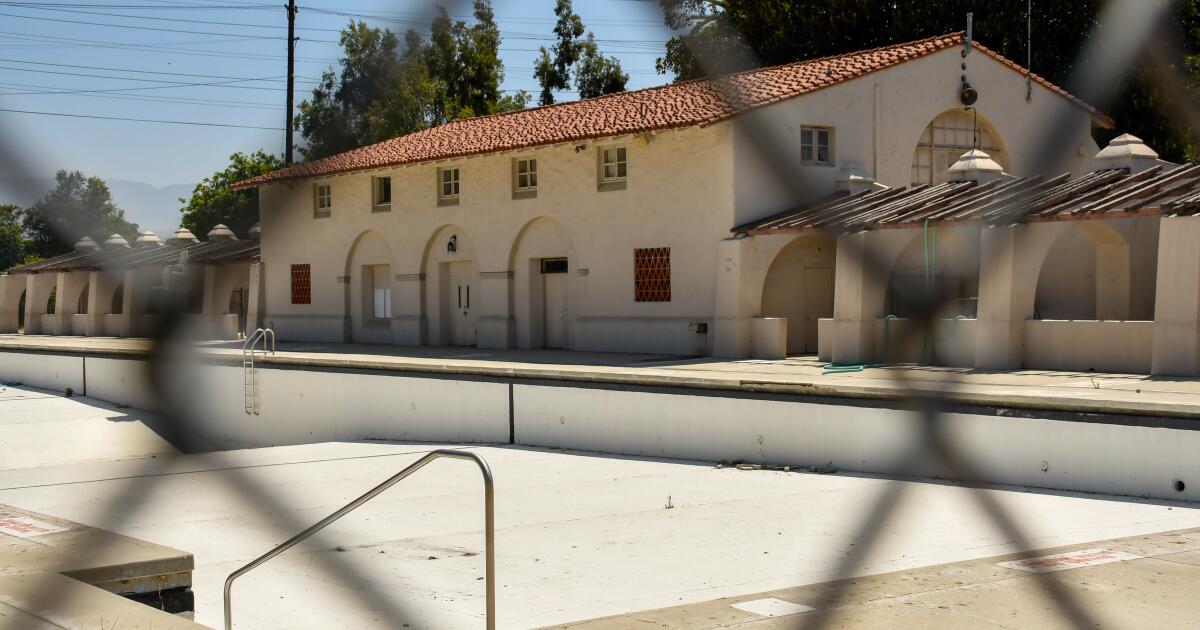
Filthy bathrooms. Damaged sprinkler systems. Deteriorating buildings. Dead trees.
The list of problems facing Los Angeles’ network of parks and recreation facilities has been well documented, with many going unaddressed for years or even decades.
On Wednesday, the City Council will take up a proposed 50% increase in the minimum funding allocated each year to the city’s Department of Recreation and Parks. But that proposal is missing a key element: a new source of funding.
The proposal, under consideration for the Nov. 3 ballot, would require a change to the City Charter, L.A.’s governing document.
The Recreation and Parks budget for the current year is about $359 million, which is above the minimum allocation of $292 million required by the City Charter.
If approved by voters, the ballot proposal would ramp up the minimum allocation over four years, putting an additional $175 million into the parks department by 2030-31. Unless council members find a new source of money to pay for the additional funding, they would have to rein in spending elsewhere.
The park funding proposal is one of several being considered for the ballot as part of a major rewrite of the City Charter. Although some proposals are on the verge of being sidelined, the park funding plan has been gaining steam, despite warnings from the council’s budget analysts.
City Administrative Officer Matt Szabo warned Monday that the park proposal would increase the size of the city’s so-called structural deficit, or the gap between the amount of money the city takes in and the amount it spends. In a seven-page memo, he also said that tying the hands of future councils by locking in spending for certain programs goes against the city’s financial policies.
The council’s rules committee moved ahead with the park proposal anyway, endorsing it with a unanimous vote. Councilmember Katy Yaroslavsky, who spearheaded the effort, said she understood why the city’s budget analysts were wary.
“But also, I’m a mom with three kids, and my boys play Little League at Pan Pacific Park,” she said. “We spend a lot of our time at Pan Pacific Park, and the bathrooms, the facilities — it’s completely unacceptable. It’s not what families and Angelenos reasonably expect, nor should they expect, from our parks system.”
Yaroslavsky, who represents part of the Westside, said in an interview that, under her proposal, much of the revenue growth projected in future budget years would need to go to the parks department. The city would also need to be more disciplined about raises for city employees and “any other new spend,” she said.
As part of her proposal, Yaroslavsky called for city officials to work with Los Angeles County on a possible 2028 tax increase to pay for park programs.
Yaroslavsky has been pitching her park proposal as a less risky alternative to one backed by a coalition of park organizations and several of her colleagues.
Under the City Charter, Recreation and Parks is entitled to a minimum level of funding equal to 0.0325% of the assessed value of all property assessed for taxes within city limits. That formula yielded a $292-million minimum during the current budget year, according to park officials.
Park advocates want voters to double that amount to 0.065%. So does City Councilmember Ysabel Jurado, who is pushing for Recreation and Parks to receive an additional $350 million per year — twice the amount sought by Yaroslavsky — starting in 2030-31.
Backers of the more generous spending plan point to a report from the Trust for Public Land, a nonprofit advocacy group that recently ranked L.A.’s park system 93rd out of the nation’s 100 most populous cities. The city spends far less per person on its parks than other comparable cities and has seen its full-time workforce shrink by 28% since 2008, said Tori Kjer, executive director of the Los Angeles Neighborhood Land Trust, which pushes for more equitable access to park space.
Kjer said Yaroslavsky’s proposal won’t be enough to restore operations that have been cut since the Great Recession.
“It continues the underfunding that has plagued this department for decades,” she said.
Last year, city officials obtained a needs assessment of the park system that found they would need $2.68 billion in one-time funding for upkeep and renovation of existing park facilities such as gymnasiums, recreation centers and green spaces.
Yaroslavsky said she agrees that the parks need more money. But she warned a larger allocation for Recreation and Parks could result in cutbacks to other core services.
“This recommendation doesn’t create new money. It sets aside existing money,” she said during a recent hearing. “Every dollar we lock in to one purpose through the charter is a dollar we don’t have for something else, like broken sidewalks, failed streetlights, street repairs, homelessness services, public safety and other basic city responsibilities.”
Last year, a coalition of park advocates announced plans to gather signatures for a sales tax hike that would generate $320 million annually for the parks department. That effort ended in February, with organizers concluding they didn’t have support from the city’s leadership, Kjer said.
With the tax hike dead, park advocates made their case to the Charter Reform Commission, the citizens panel that was reviewing changes to the City Charter. The commission endorsed the idea of doubling the allocation for parks and recreation programs.
The council doesn’t need to rewrite the City Charter to increase the amount of money it spends on parks. That option, Szabo said in his memo, is available to the council each year that they take up the mayor’s proposed budget.
Jack Humphreville, who serves on the Neighborhood Council Budget Advocates, a watchdog group, said he supports the idea of doubling the allocation for Recreation and Parks — even if it raises the likelihood of a larger structural deficit. That agency is among the most important in the city, he said.
If the proposal makes the ballot and is approved, city leaders will need to look at a number of cost-cutting options, such as limiting the size of the raises given to city employees.
“They’re going to have to make some very tough decisions,” Humphreville said.
The post L.A. voters could be asked to boost spending on parks. Finding the money comes later appeared first on Los Angeles Times.