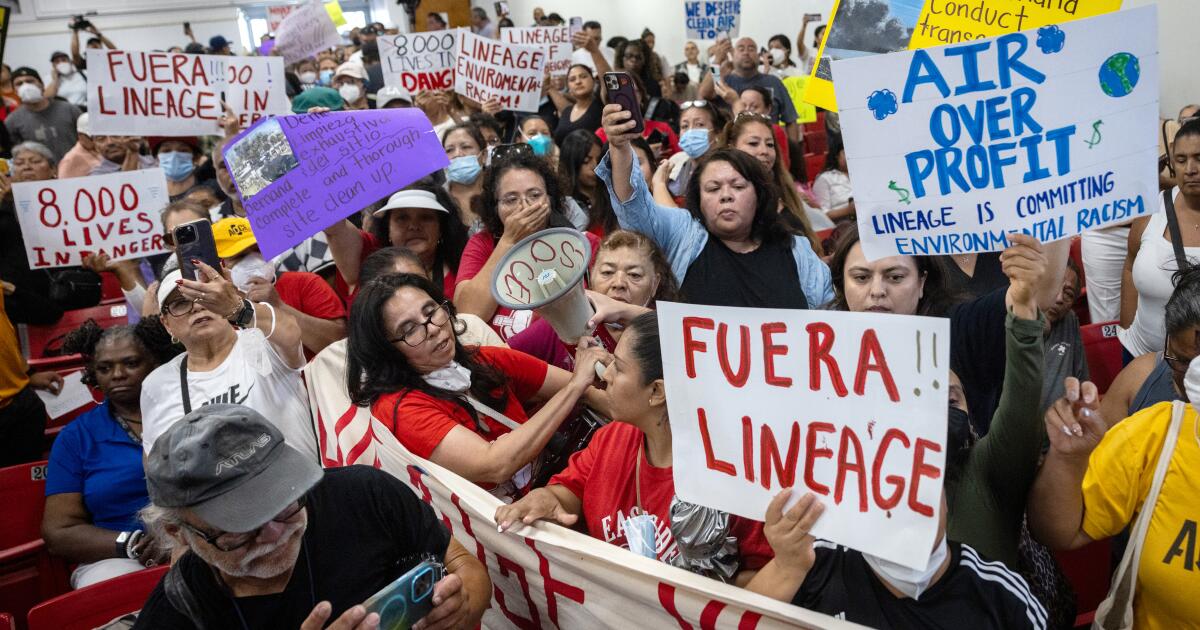
All of the Eastside neighborhood types that make the Eastside the Eastside showed up last night at Stevenson Middle School for that most Eastside of traditions:
Give flailing politicians righteous hell.
It was the first public town hall about the Lineage warehouse fire, which burned for nearly a week and left 85 million pounds of frozen food rotting across the street from residential neighborhoods. All 400 seats in the sweltering auditorium were filled, with an additional 300 people in the cafeteria. Dozens more lingered in the parking lot and on the lawn.
There were the activists who marched nearly a mile from the burnt-out warehouse to push past security and enter the auditorium, chanting “Shut it down!”
There were taqueras like Monica Susteyta and Cristina Flores, who ran stalls on Union Pacific Avenue within sight of Lineage until the fire shut them down last month. Susteyta has yet to reopen. Flores tried this week, out of financial desperation, but has yet to make a sale, “because there’s just too many flies.”
“We can’t work, our kids can’t play outside. It’s worse than the pandemic,” the 41-year-old continued in Spanish.
“The mayor said the smoke wasn’t toxic,” added Susteyta, 50. “How was it not, when one cigarette is poison?”
A mariachi played, highlighting the loss of gigs for local musicians, with backyard parties on hold amid the stench that still hangs over the area. Elderly immigrants showed off injuries they claimed were caused by the noxious air: strange blotches on their skin, temples rubbed raw due to watery eyes.
And then there were Eastside lifers like 77-year-old Ross Valencia, who attended Stevenson just like his father and stood in line for two hours to secure a seat.
“How many things have to happen to the Eastside?” the Navy veteran sighed, mentioning a May oil spill on Cesar Chavez Avenue that polluted the Los Angeles River, the Lineage blaze and a car that ran over a group of people enjoying their lunch at Los 5 Puntos earlier in the week. “There’s a lot of pissed-off people today. Normally, I’m peaceful, but …”
His face scrunched as a breeze that smelled like vomit hit us. To the south, what remained of the Lineage warehouse loomed on the horizon just over the 5 freeway, its burnt-out walls covered in white plastic sheets and its charred roof still exposed. The hulking structure looked like a giant, putrid sheet cake.
No single official has emerged to take charge, because no one really can be in charge. The warehouse is right on Indiana Street, the dividing line between Boyle Heights, which is in the city of Los Angeles, and unincorporated East L.A.
Although L.A. Mayor Karen Bass, L.A. City Councilmember Ysabel Jurado and L.A. County Supervisor Hilda Solis have tried to cut through jurisdictional red tape, many residents complain that they’ll ask one office for help, only to be directed to another.
“To officials, Indiana is a border,” said mark! Lopez, an organizer with East Yard Communities for Environmental Justice whose grandmother was a co-founder of the famed Mothers of East Los Angeles. “Not to the people who actually live here.”
The town hall was a chance for someone, anyone, to take the lead and say something that would reassure a furious Eastside.
Not tonight.
“Good evening, everyone,” Bass began over jeers, in the tone of an elementary school teacher who knows her students are going to act extra. She apologized “straight up” for any “confusion, miscommunication,” which only got people more upset — but not as much as when she tried to calm them down by saying, “If you want to listen, clap once.”
Oh, people were listening — they just weren’t going to stay quiet about what they heard.
Solis, who represents East L.A. on the Board of Supervisors, followed to even louder boos as she offered pabulum that sounded like she’s already packed up her U-Haul in preparation for her likely election to Congress this fall.
Jurado tried to remind people that she was once a fiery activist, like so many in the audience. Her 2024 city council upset win was the first time she’d run for office.
“Community has always come out for community, and it’s my job that we hear your voice,” she said.
But when Jurado sarcastically introduced the next speaker — “Your favorite, Lineage, will now present!” — the joke fell flatter than a solar panel.
Lineage Chief Operating Officer Jeff Rivera repeatedly uttered what everyone wanted to hear: “I am sorry.”
That was the only highlight of his presentation. His PowerPoint slides were unreadable because of small text and the auditorium’s bright lights. The audience snorted when he said that tests showed the air was safe to breathe. They retched when he complained, “I know you’re upset. We’re upset. Our building burned down.”
Below the speaker’s podium sat a row of bored-looking representatives from city, county and regional agencies. Some looked down at their phones, texting as members of the public slung question after question that Abigail Marquez, general manager of L.A.’s Community Investment Department, largely couldn’t answer. The only official who said anything of any note was Barbara Ferrer, the L.A. County public health director.
“We failed,” she admitted, describing how community health groups stepped up to assist residents in a way that her staff hadn’t.
Rivera vowed that Lineage would provide cash assistance, air conditioners, air purifiers and even help paying utility bills. Bass announced that AirBnB would help to temporarily relocate people. She vowed to study all the warehouses in the Eastside, South L.A. and the San Fernando Valley to “evaluate them for their potential for environmental problems.”
But the more the authorities talked, the more the crowd wouldn’t have it.
For decades, the powers that be have burdened the Eastside with freeways, warehouses, public corruption, unsightly developments that have brought on gentrification and civic negligence bordering on the criminal.
What especially infuriated people was that in the fire’s first days, Bass and others had insisted that the plume of black smoke dumping ashes as far away as the San Gabriel Valley was nothing to worry about — an attitude they would never dare take in wealthier parts of the city.
The Eastside never seems to win at City Hall or the county Hall of Administration. It’s been up to regular folks like East L.A. resident Silvia Corona, who has protested everything from environmental racism to gentrification to anti-immigrant laws for nearly 50 years, to try and save the area from even worse.
“Pongansen las pilas, por favor,” Corona pleaded to cheers from the audience. Please put on your batteries — a Mexican Spanish idiom that means to cowboy up. “You don’t listen to us. For God’s sake, we’re tired.”
After nearly two hours, the residents filed out of the auditorium. Some passed out fliers with information about resources. They exchanged phone numbers and Instagram accounts. They weren’t going to wait for promises that would probably never materialize.
A Boyle Heights resident who gave his name as El Chavo, the beloved Mexican
children’s television character who lives in a barrel in a working-class neighborhood, compared the official response to the fire to the meme where Spider-Man points at an imposter dressed just liked him, who returns the gesture.
“It’s like they’re all at a potluck, but no one is coordinating on what to bring or who to invite,” El Chavo said.
Nearby was Genesis Coronado, who had stood up and turned her back every time Solis spoke.
“It’s absurd when I have to call Ysabel Jurado’s office for help, instead of my actual representative,” the 34-year-old East L.A. native said.
I asked her how Solis and the other leaders had performed at the town hall. A new breeze baptized us in another vile stink.
“Absolutely terrible,” she said. “You had no answers, you had no nothing.”
The post The Eastside is fed up. And the politicians aren’t listening appeared first on Los Angeles Times.