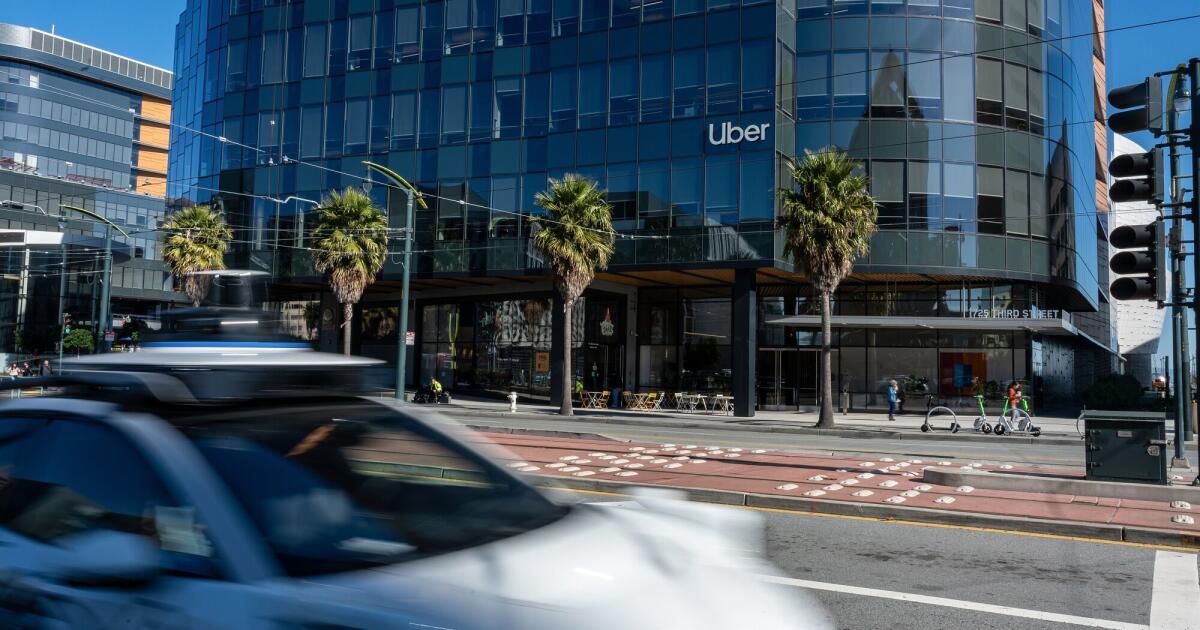
The breakdown of Uber Technologies Inc.’s robotaxi partnership with Alphabet Inc.’s Waymo is looming large over the ride-hailing giant’s quarterly results, as investors grow anxious about the stock that has lagged the broader market this year.
The shares of San Francisco-based Uber have slumped 28% since reaching a record high of $100.10 in October while the S&P 500 Index gained 13%, and the technology-heavy Nasdaq 100 climbed 15% over the same period.
Analysts and investors say that even strong performance in its mobility and delivery segments won’t be enough to send shares back toward their record high. That’s unless the company is able to show its endeavors to offer self-driving taxis on its platform are going according to plan.
“A clean mobility print would stabilize sentiment, but a durable recovery requires Uber to address the structural question head-on,” said Dave Mazza, chief executive officer at Roundhill Financial.
Investors want proof that Uber’s push into vehicle autonomy will expand its ride-hailing business, Mazza added.
“That proof comes from deployment numbers, not commentary,” he said.
Uber has partnered with a slew of companies working on autonomous driving technology in recent years, including privately held Nuro Inc. and Amazon.com Inc.’s Zoox. Still, a partnership with Alphabet’s Waymo — widely seen as the market leader in the space — carried its own weight.
It explains why the market reacted strongly to the news of the pact falling apart. First, in June, Uber wound down its robotaxi partnership with Waymo in Phoenix. Then in late July, news that Waymo is exploring options to exit its existing, exclusive robotaxi partnership with Uber sent the stock down 4% for the day.
It is still possible that the companies would come to an understanding that would allow Waymo to have its vehicles both on its own app and the Uber app.
The unwinding of the exclusive pact prompted Morningstar analyst Mark Giarelli to lower his fair value estimate on Uber to $76 per share from $85, citing growing competition from Waymo, especially in urban areas where Uber commands a strong pricing power.
Roundhill’s Mazza said his firm would sell its Uber shares if autonomous-driving firms like Waymo can prove that they can run and scale without a centralized ride-hailing network.
“Until then, the math still favors the platform,” Mazza said.
Uber, meanwhile, still sees “very, very healthy trends” in markets like San Francisco where Waymo has operated for some time, CEO Dara Khosrowshahi said during the company’s first-quarter earnings call in May.
Meanwhile, Waymo’s fleet consists of over 3,000 vehicles across more than 10 US cities, which is just a small fraction of Uber’s current operations.
The current declines in Uber shares come as the broader market is souring on high-flying artificial intelligence stocks, with investors getting wary about riskier growth names with an ambitious but still-unproven strategy. Though Uber isn’t a big AI spender like Waymo-backer Alphabet, or Meta Platforms Inc., and therefore has avoided the worst of the backlash against swelling capital expenditures, the firm still has to prove that it can turn its lofty promises into concrete profits.
Uber shares trade at about 18 times their 12-month forward earnings estimates, below the S&P 500’s average of 20. To some, that muted multiple suggests any decline in the stock can stay limited.
It also partly explains why Wall Street remains fiercely bullish on the stock. Of the 58 analysts covering Uber, about 86% recommend buying the stock, according to data compiled by Bloomberg. Only one analyst has a sell rating. Analysts are not nearly as optimistic toward Lyft Inc., with only about one-third recommending buying the shares.
Despite being convinced about Uber’s long-term prospects, analysts are paring their short-term earnings outlooks. Estimates for Uber’s 2026 annual profits are down over 17% from a year ago, according to data compiled by Bloomberg.
“If anything, it tells me the Street is becoming more patient about the timing of the payoff rather than questioning the underlying business,” said Haris Khurshid, chief investment officer at Karobaar Capital, which owns Uber stock.
Fitzgerald writes for Bloomberg.
The post Waymo rift leaves Uber’s robotaxi ambitions on shaky ground appeared first on Los Angeles Times.