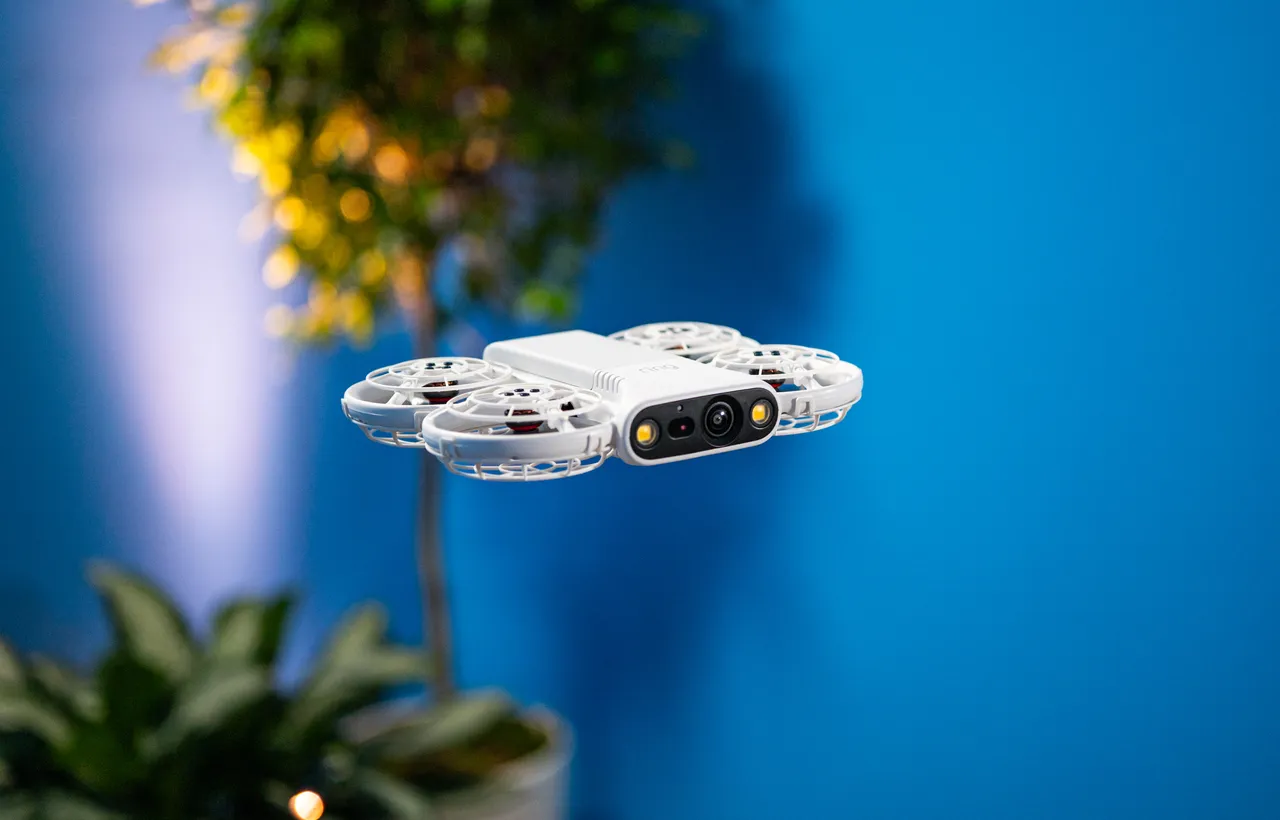
No one’s home tonight, but the sensor on your home office window upstairs alerts your phone: “Motion detected.” Maybe it’s just your cat, or a flicker of a passing car’s headlights. Instead of shrugging it off, you ask Alexa to send your Ring Drone Cam to check it out.
The tiny, 165-gram drone lifts out of its charging dock, buzzing loudly, and autonomously flies upstairs, giving you a first-person view on your phone’s screen as it scans the room. Since it’s dark in the house, the Drone’s spotlights kick in, making it look like someone’s physically in the home and moving around—a potential deterrent to would-be thieves. All clear? It heads back to its base to recharge.
That’s the peace of mind Ring wants to offer with its latest home security solution, which it announced today for $250, alongside the Ring Rover Cam, a $1,000 roving security robot designed to help businesses monitor warehouses and factories. Both fall under the company’s new “Ring Robotics” brand. The Rover Cam launches first on December 16, followed by the Drone Cam on January 27, 2027.
This isn’t the company’s first at-home drone camera. CEO and founder Jamie Siminoff says he had the idea for a flying sentry in 2016 before Amazon bought Ring. The company previously announced an indoor security drone in 2020—the Ring Always Home Cam—and nearly launched it last year. But Siminoff says the team kept running into edge cases that forced them to add more sensors. Those additions required more computing resources and made the drone more power- and battery-hungry, and made it harder to fly. The new solution? Move the intelligence off the vehicle and into the cloud.
The Drone Cam has enough smarts to land if it loses internet connectivity, but the rest of its intelligence now sits entirely in the cloud; the drone sends video straight to Ring’s servers, where a custom “AI Pilot” agent tells it where to go. That lets the drone be lightweight and nimble.
It will avoid people and objects, and if you accidentally manage to stick a finger into the propellers, Siminoff says you will feel it, but “you’ll be fine.” If your cat manages to swat it out of the air, however, that’s a different story. A Ring spokesperson tells WIRED customers shouldn’t “fly it” if it’s damaged and should contact support for help (no word on repairability). The Drone Cam runs a motor health check before take-off every time and won’t fly if it detects a problem.
Users can’t manually control the drone, but can set up custom flight routes and patrol schedules. It can automatically respond to alerts from security sensors you may have set up in the home, like motion, door, or window sensors. It will not leave your home, as it needs a Wi-Fi network to operate and uses the Alexa Home Map you may have created with existing Echo devices to help it navigate. It can fly around five to eight minutes per charge. (Also, the final production model will be black, not white like in the pictures.)
“There are times when you do want to just be able to see everywhere around the home, but you don’t necessarily want a [fixed] camera,” Siminoff says. “That’s why we invented Ring Robotics.”
Because it doesn’t work outdoors and since it’s well below the 250-gram threshold, the Drone Cam doesn’t need to be registered with the Federal Aviation Administration. Drones have also struggled in the US after the Federal Communications Commission banned DJI from importing foreign-made drones without certification. But Siminoff says the Drone Cam complies with all US regulations and is assembled in Texas.
But what if a bad actor gets access to the Drone Cam? Siminoff points to the company’s TAKE technology, or Throw Away the Key Encryption. It encrypts video in transit and rotates keys every few minutes, but Ring temporarily holds the key to run cloud-based AI features before deleting its copy. That brief server-side access window makes it not as foolproof as true end-to-end encryption. (Every Ring account does require two-factor authentication to log in.)
Hackers have also invaded smart home devices and peeked through robot vacuum cameras, baby monitors, and other gadgets, so it’s not hard to imagine a similar situation with the Drone Cam. To counter the threat of surreptitious surveillance, Siminoff says the Drone Cam is loud by design—the extremely loud buzz of its propellers means a bad actor couldn’t remotely snoop without tipping off people in the home.
Concerns don’t just stem from third parties trying to access your devices, though. Amazon’s Ring has been accused of normalizing suburban surveillance, partly stemming from the company’s cozy relationship with law enforcement, where it has even handed Ring videos to cops without warrants.
Thorin Klosowski, senior security and privacy activist at the Electronic Frontier Foundation, says a device like the Drone Cam is a personal choice and that people should “think through” how it will make others in the home—or visitors—feel.
“I think the companies who make these sorts of surveillance products are invested in us feeling less safe at home,” Klosowski says. “If there is a way to sell a product that helps alleviate the problem they are creating, I think they will do it.”
Ring Robotics’ second robot is designed for businesses, not consumers. The Ring Rover Cam might look familiar—it shares many of the same hardware guts as Amazon’s Astro, the short-lived home robot that didn’t do much. Amazon had even pivoted it as a $2,350 security robot for businesses before eventually bricking them 10 months after launch.
Siminoff says the robot was great, but the software needed polishing, and people largely wanted to use Astro for security—that’s why the Rover Cam ditches the cute face seen on the previous bot. It has the same AI Pilot as the Drone Cam, which helps it navigate through spaces and avoid obstacles. A telescoping 4K camera pops up to monitor its surroundings, and the Rover beams a light circle to the ceiling so you can always glance up to see where the short bot is on the factory floor.
It responds to sensor alerts, can automatically check an area, features two-way talk, and has a built-in siren. It covers up to 5,000 square feet and returns to its charging dock after its patrol ends (it can do about 30 minutes). It’s significantly cheaper than Astro was, but buyers still face the lingering risk that Amazon could pull the plug if Ring Robotics doesn’t pan out.
The post Ring’s Indoor Drone Camera Is Back—and Now Powered by AI appeared first on Wired.