With her fingers, Guadalupe Espinoza lightly traced the lettering engraved on a slanted monument wedged alongside the courtyard at the LA Plaza de Culturas y Artes.
The memorial was installed in 2012 as a way to acknowledge — alongside a formal apology by the California State Legislature and the Los Angeles County Board of Supervisors — the history of Mexican and Mexican Americans who were forcefully removed from the United States during the Great Depression.
“It’s the beginning of helping everyone, starting with the families, learn about what happened to them,” Espinoza said of the monument. “For this to be known and not forgotten or swept under the rug.”
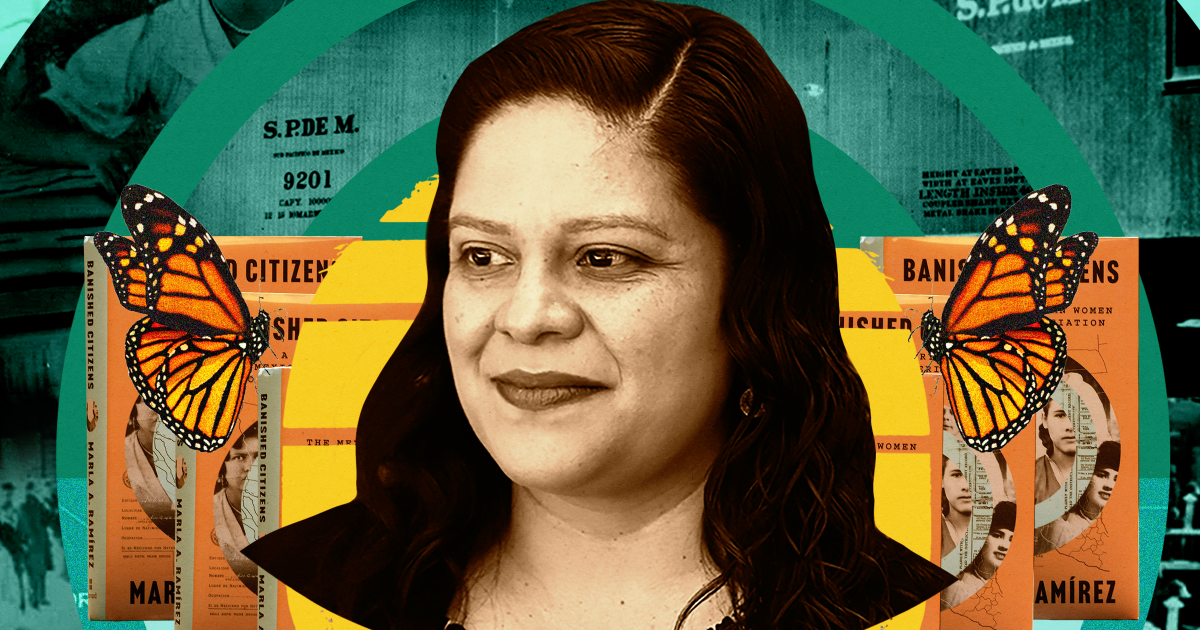
The commemorative plaque and apology are also the starting point of a new book by Marla A. Ramirez titled “Banished Citizens.” Released in November 2025, it details how Mexican American women endured the repatriation period, relying primarily on oral family histories.
Between 1921 to 1944, approximately 1 million individuals of Mexican descent living in the United States were sent to Mexico. They were scapegoats, Ramirez argues, part of a mass removal effort to reduce the country’s relief expenses and unemployment rates. Sixty percent of those expelled were U.S. citizens, mainly working-class women and children in a mixed-status household.
Among those removed were individuals such as Espinoza’s mother, Ramona Espinoza (née Garcia) who, despite being born in San Dimas in 1928, boarded a Mexico-bound train alongside her three siblings (all U.S.-born citizens) and their Mexican-born mother, Felicitas Castro, who received a repatriation letter ordering her removal from Los Angeles in 1932.
Ramona — who was still alive at the time that Ramirez conducted oral interviews with her for her book — believed her family’s removal came from vaccination records at Los Angeles General Hospital, which denoted the family as “likely to become public charge,” or someone who depended on the government for survival, then a clause for expulsion under the 1917 Immigration Act.
At times facing housing and food insecurity in northern Mexico, Ramona would eventually find her way back to the U.S. as a seasonal farmworker in the Imperial Valley, helping fill in the worker shortages of World War II. She would not permanently resettle in Los Angeles County until 1948.
“We had to do many years of healing from all the trauma and hardships that they learned to live,” Guadalupe said. “Even now, I get very sad when I think of what happened to my mother and my grandmother — sometimes it’s [looking] at a document in my hand, sometimes it’s standing in a place where I know my grandmother brought her children a hundred years ago.”
Ramirez — an assistant professor of history and Chicane/x and Latine/x studies at the University of Wisconsin-Madison — is careful when highlighting the word repatriation in her book, which she argues invokes the act itself as a voluntary return for noncitizen immigrants.
Instead, she elects the word banishment to describe the expulsion of U.S. citizens to their ethnic country of origin, despite their legal right to remain in the United States. For her, the word is an apt description of what happened to these families, whose descendants continue to face the repercussions of being “thrown out.” Many banished individuals struggled to legalize their Mexican-born children, others were unable to access formal education.
“If we don’t know our history, then we don’t know how to respond to the current moment,” Ramirez said as she conducted interviews between 2012 and 2017. “When I give talks about the book and share the family features I write about, the question is, how do you see this being replicated today?”
Now with the landmark case of Trump vs. Barbara before the Supreme Court, which will likely be decided in late June, the topic of birthright citizenship is especially salient.
“My God. Really? 90 some years and we’re back to square one,” said Jose Isabel “Chabelo” Villegas, whose mother Sara Marie Robles was banished in 1932 as a 4-year-old girl. “Let’s not kid ourselves, it’s not about the number of people in this country … it’s, ‘We wanna clear it as many non-white as possible.’”
Holding Ramirez’s book, Villegas flipped through the pages until he reached the chapter on his own family’s story. He grew teary-eyed after looking at a picture of his mother on a park bench in Pasadena, Calif., the city in which she was born in 1926. She didn’t remain there long enough to take advantage of any academic opportunities afforded to U.S. citizens.
“This picture didn’t mean anything to me when I first saw it,” Villegas said. “To know that she was cheated out of a U.S. education is very difficult to deal with.”
By age four, Sara Marie would travel to Mexico due to anti-Mexican sentiment. The Immigration Act of 1929 — which criminalized border crossings — was motivated by pseudoscientific racism, describing Latin American immigrants as “mongrelized,” “peons,” “degraded” and “mixed blood.”
At first, Villegas did not understand the details of his mother’s arrival in Zacatecas, Mexico, where he and all his 10 siblings were born. Sara Marie herself was unaware that she could pass on her citizenship to her Mexican-born children and instead relied on a lengthy petitioning system that kept her separated from her family for years.
“After we came in 1977, for one year only, all of us lived together in one little house, all 13 of us,” Villegas said. “That was the happiest year of my life.”
The discourse surrounding birthright citizenship also comes at a strenuous time for many migrants, Villegas included, who is a naturalized citizen despite his mother being born in the United States — especially as the Trump Administration continues its plans for mass deportations, increasing immigrant detention capacity across 11 new warehouses and ramping denaturalization efforts at an unprecedented rate.
“Not only do we want to take away birthright [citizenship], that’s one group,” Villegas said. “Now we want to go after those that came here and are now U.S. citizens, which can backtrack and I can end up as an illegal immigrant.”
In response to Villegas’ comments, Espinoza — who was born in Torrance, Calif. in 1952 — pulled out her U.S. passport. “I have been carrying this now for about a year and a half,” she said.
Sore from the torment of her family’s banishment, Espinoza feels the pulse of current events.
“ We had hoped that we could prevent this, but obviously the battle is stronger than we thought,” Espinoza said.
While Ramirez understands that immigrant communities are currently under attack, she says her hope is for the stories of these banished families who fought long hard to return to their country of origin can inspire readers to turn despair into action.
“It’s okay to feel afraid but it’s also okay to remember that we’ve been here before and that people persisted,” Ramirez said.
The post Marla Ramirez’s ‘Banished Citizens’ explores historic expulsion of Mexican Americans. Will it happen again? appeared first on Los Angeles Times.