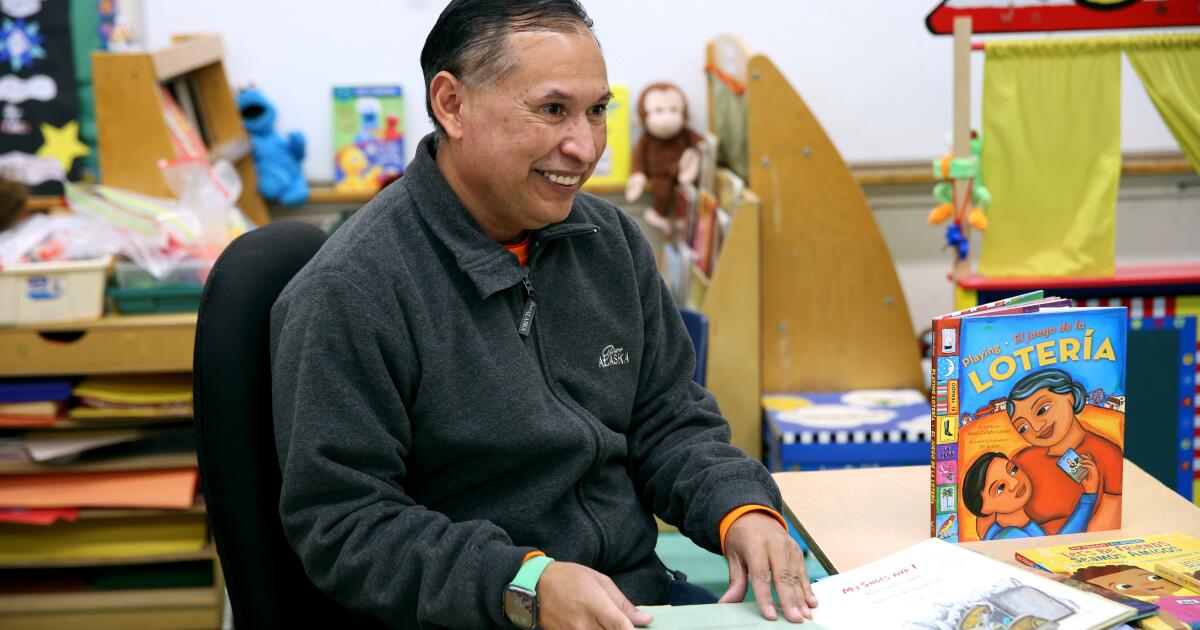
California’s ambitious goal of having half of all K-12 students enrolled in bilingual education programs by 2030 has encountered one big stumbling block — there aren’t enough qualified bilingual teachers.
To help remedy that, a $10-million grant tucked in the state budget aims to help school districts recruit high school students as future bilingual teachers.
The fundingallows schools to partner with community colleges and universities to help students obtain a teaching credential and the bilingual authorization required to teach English learners.
Assemblymember David A. Alvarez (D-San Diego) said the idea for the legislation came in part from school districts that communicated about their struggles to find qualified bilingual teachers.
“I kept hearing from districts and educators that bilingual students want to become teachers but run into a fragmented system with no clear path through high school, community college, university and credentialing,” Alvarez said.
Researchers and coordinators of bilingual teacher preparation programs applaud the new grant program, but say it’s not nearly enough to meet the state’s needs.
“Grant funding is important, but to me it just doesn’t feel like it’s going to be enough, given our size and also the size of our dreams and our ambitions as a state,” said Lucrecia Santibañez, a UCLA professor and author of two recent reports on bilingual teacher preparation.
High demand for bilingual teachers
California set a bold vision eight years ago to enroll half of all K-12 students in programs that help them become proficient in two or more languages by 2030.
But to reach that goal in the next four years, California will need an estimated 6,000 more bilingual teachers.
Several recent reports say not enough bilingual teacher preparation programs exist, and those that do are too far from the districts with the highest demand for instructors.
In addition, bilingual students interested in becoming teachers are often stymied by the extra cost to finish both a teaching credential and a bilingual authorization — which requires several classes and 20 hours of student teaching, and can cost anywhere from $1,500 to $4,000 on top of a college degree.
California has more than doubled the number of bilingual authorizations issued to teachers annually, from 617 in 2014-15 to a record 1,370 in 2023-24, according to the Commission on Teacher Credentialing. Yet Santibañez and other UCLA researchers found that districts issue hundreds of emergency bilingual teacher permits each year for teachers who are not fully qualified.
The demand for bilingual teachers is not the same everywhere. While some districts have developed thriving dual language immersion programs and found ways to increase their numbers of bilingual teachers, many others lack the teachers and the funding to build these types of programs.
“We’ve worked with districts that have had to close programs they started, and they just couldn’t staff it,” said Anya Hurwitz, executive director of SEAL, a nonprofit organization that provides bilingual curriculum training for school districts. Other districts have built more robust relationships with teacher prep programs, but those are not the norm, she said.
Bilingual teaching deserts
The areas in California with the greatest need are also the areas where preparation programs are scarce or underfunded, UCLA’s Santibañez said. Imperial County on the Mexico border, as well as Kings and Tulare counties in the Central Valley all have large English learner populations but do not have nearby preparation programs.
“We know from the research that teachers and students in college who decide to become teachers like to stay close to where they live,” Santibañez said.
Fewer established bilingual teachers in an area also means there are fewer teachers who can serve as mentors for student teachers, she said.
Starting in high school
The new legislation gives grant priority to school districts with a high percentage of students who are English learners and not enough teacher preparation programs.
Sparking interest in bilingual teaching among high schoolers, as the new grants would do, is crucial, said Adam Sawyer, director of the bilingual authorization program at California State University, Bakersfield. He said his university helps as many as 30 credentialed teachers get their bilingual authorization every year, and also has a bilingual teaching residency established with local elementary school districts.
Sawyer said CSU Bakersfield is working to establish an undergraduate pathway for prospective teachers and a dual-enrollment course for high schoolers, which will start next year.
Still, the new funding, which will be distributed in grants of up to $600,000, is not a lot to address the need, educators say.
“It’s a drop of water in the sea,” said Eduardo Muñoz-Muñoz, San José State University professor and co-author of a report by the California Assn. for Bilingual Teacher Education and Californians Together.
Santibañez and Muñoz-Muñoz also recommend the state offer more financial aid for students working on bilingual authorizations on top of their teaching credentials, a stipend for students to complete student teaching in a bilingual classroom, or bonuses for teachers who have bilingual authorizations, which not all districts provide.
“There’s just got to be an incentive,” Santibañez said. “You’re a college student, right? You’re getting your teaching credential, and you speak Spanish. … So getting a bilingual authorization seems like something like a slam dunk, right? But you have to pay for it.”
Stavely is a reporter for EdSource, a nonprofit, nonpartisan journalism organization covering education in California.
The post Short thousands of bilingual teachers, California schools turn to high school students appeared first on Los Angeles Times.