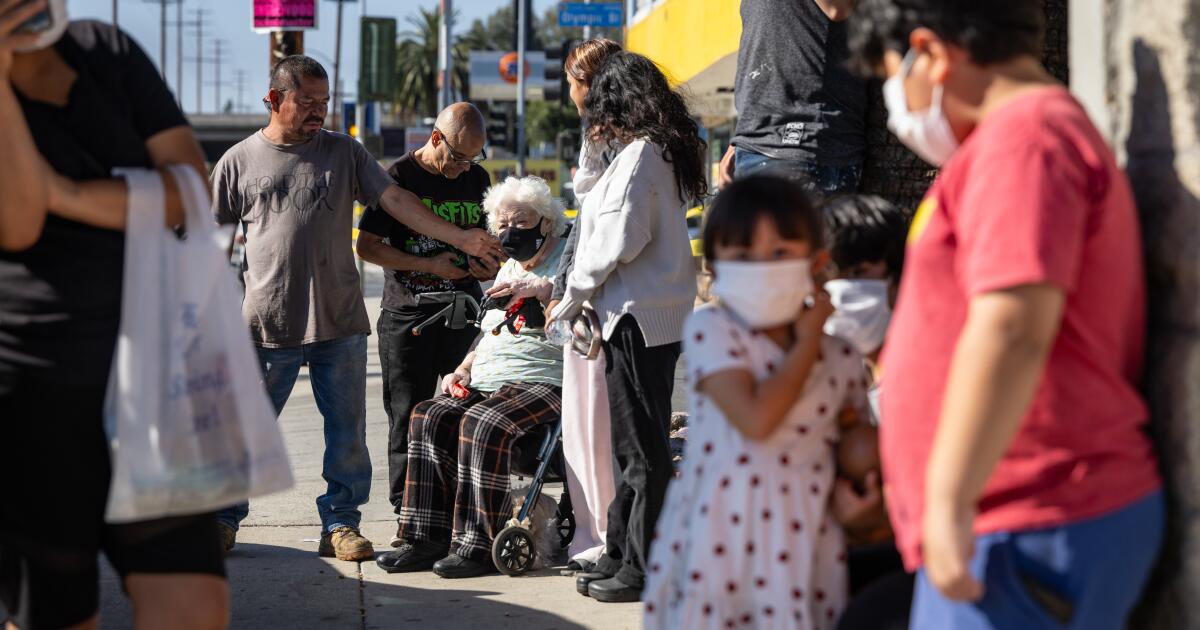
It’s been feeling practically biblical around here lately — and it’s not the feeling of holiness.
Those odors coming from the warehouse fire in Boyle Heights aren’t the odors of sanctity. They’re the stench of smoke and soot and chlorine, and of burning, rotting, rat-besieged food. They’re from melting insulation foam and whatever it is that gets airborne when fire assails solar panels.
How many malodorously toxic episodes does that make toward the seven plagues in the Old Testament?
That depends. Are we counting since forever or just this year?
Every now and then — as in now — some business operation somewhere in Southern California blows up or burns down, and we are surprised to learn that something like this, something odiferous, pestiferous, even maybe dangerous, was here the first place.
Most often these are industrial accidents, some process going awry, whether by fizzled technology or human error. And most often these fires, explosions and leaks happen in working-class neighborhoods. Why?
In the great plain of Los Angeles itself, it is a chicken-and-egg process. Neighborhoods were built near existing, potentially dangerous industries because the land was cheaper. And conversely, industrial businesses moved into working-class neighborhoods because the land was cheaper and the zoning sometimes iffy. And, as usual, that meant many people of color wound up living with hazardous chemicals and heavy metals as neighbors.
But distant suburbs have not been immune to such calamities.
More than 30 years ago, something went wrong at Rockwell International’s enormous rocket-engine test site in the Simi Hills, and two engineers were killed in the explosion.
Already, for almost five decades before that 1994 accident, aerospace research and development firms at the Santa Susana Field Laboratory site had been testing rocket engines for government projects. Kids who grew up near those hills remember the rumble and roar of Rocketdyne testing another rocket engine and the cloudbanks of smoke from the test firings. It was the soundtrack of the Cold War and the space race.
The toxic byproducts of developing solid fuel and nuclear technologies were not long in arriving. The whole periodic chart of elements and metals and all kinds of chemical concoctions found their way into the ground and the groundwater.
The mess is still being cleaned up.
The news stories about accidents at such plants are usually about employees who have been hurt or died. But once in a while, as in Boyle Heights, things go blooey big time.
In September 1988, as many as 27,000 people were evacuated for up to 12 hours from parts of Montebello, the city of Commerce and East Los Angeles. About a ton of smoldering chemicals in big drums had released chlorine-compound fumes. Sheriff’s deputies had to force a few diehard gamblers away from their games at a casino in Commerce.
Back then, a local named Jose Luis Alvarado gave voice to what some of his neighbors were likely thinking. “I’ve lived here for five years and you never really think about such things. Now you have to think about the consequences,” he said.
The Grow Group Inc. chlorine cloud was one of the incidents that prompted L.A. County, like the state, to require companies handling a certain amount of hazardous materials to make annual detailed reports to L.A. County fire officials. This doesn’t mean that residents have access to a kind of Megan’s Lawlist to be able to find out who is brewing what chemistry concoctions in their neighborhoods, though.
Sometimes people don’t need notifications. The accidents at refineries in the cities of the South Bay are most spectacular — stinky or flashy, with flames you can see on the TV news if not from where you live.
Last October, a roaring blast and fire at Chevron’s El Segundo plant stayed within the refinery footprint but the noise shook the neighborhood and turned the sky sunset-orange, then smoky. “I thought we got nuked or something,” one man who had been outside playing soccer told The Times.
An October 1992 Texaco refinery explosion in Wilmington blew out windows, shook houses like an earthquake and puffed out potentially toxic vapor that went downwind. In March 1989, a midday tube rupture at the Chevron refinery in El Segundo sent cleaning solvent-filled steam into the air and trashed the paint jobs on about 2,000 neighboring cars and trucks. In January 1992, a steam blast at El Segundo injured 10 workers.
Between 1979 and 1992, a series of accidents and two major fires at the Mobil refinery in Torrance left six dead and scores injured.
Year in and year out, in incidents small and noticeably larger, refinery accidents enraged neighbors and attracted regulators. Now, according to a state website, in Southern California, there are four major refineries that handle about two-thirds of the state’s crude oil capacity.
What were the refineries doing there in the midst of the urban plain in the first place? Let me quote the old drinking song of the private Uplifters Club in the Pacific Palisades: “Yes it’s oil, oil, oil that makes L.A. boil.”
Underground, L.A. is practically aslosh in the stuff, and has been, for as long as 10 million years or so. The vast oilfields of Long Beach and Wilmington and Signal Hill are still yielding it. Over almost 150 years, at least 9 billion barrels of oil have been sucked out of the ground and converted to petrodollars that in the 1920s and ‘30s made L.A. one of the biggest players in oil markets.
Homeowners of that era ripped out their vegetable gardens and orange trees to set up oil rigs. That’s a lot of oil, but 9 billion barrels, by the U.S. Geological Survey’s reckoning, is now only about what this country uses up in 14 months.
The ground sometimes stank of the stuff, with open ponds that finally were ordered covered, with spills and seeps from wells and tanks that hinted at the long plumes of oily stuff underground. Early on, refinery waste was sometimes just carted away and dumped, as happened in Fullerton in World War II. A golf course and wildlife space now sit on that site. Three million tons of petrochemical waste got dumped right into the Pacific Ocean.
It was more than oil, oil, oil that made L.A. boil. Even small industrial shops routinely used chemicals of some kind and quantity, with all the risks.
In late May, about 50,000 people in Orange County were evacuated because, at a Garden Grove site operated by GKN Aerospace, tanks holding a volatile hazardous chemical called methyl methacrylate were at risk of exploding or leaking toxics. At a Garden Grove council meeting about it, one resident complained, “We cannot sleep at night with the GKN monster under our beds.”
For years, almost any open space far enough out of sight looked like a why-not dumping ground. In 1980, along the Pearblossom Highway in northern L.A. County, 18 barrels of polychlorinated biphenyl were left out in the desert. Matters got worse after passersby with guns pinged holes in some of the barrels, and the poisonous stuff soaked about 15 feet down into the desert soil.
In 2015, a battery recycling plant that had been operating in Vernon for decades had to close down and pay $50 million toward cleaning up its hazardous wastes such as lead dust, cadmium and arsenic.
Hazmat materials got dumped right into rivers and tributaries. It sometimes took years for people to find out that their headaches or nosebleeds or breathing pains and nausea could be traced back to that business maybe only a few blocks away.
The worst natural gas leak in the nation’s history happened in 2015 in Aliso Canyon, and 11,000 people were evacuated from their Porter Ranch homes. It took 112 days for the methane leak from the Southern California Gas Company’s underground storage to be finally capped. In that time the methane that got into the atmosphere was as much as the emissions of a half-million cars.
A toxic dump that humans couldn’t see or smell wrought perhaps the worst damage on the ocean in one place from a single poison. Over several decades, hundreds and hundreds of tons — hundreds of thousands of gallons — of acid waste from the pesticide DDT and even DDT itself were dumped into the ocean off the Palos Verdes Peninsula and near Catalina Island.
DDT is a pesticide so dangerous to the environment that it was banned worldwide more than 50 years ago, with rare exceptions; its effects are still traceable in the environment today.
Montrose Chemical Corp. in Torrance was the nation’s biggest manufacturer of DDT, and environmental authorities concluded only a few years ago that it had dumped DDT and byproducts first into L.A. sewers — a reported average of more than 600 pounds a day — whence it flowed into the ocean and later poured the toxic liquid straight from tank barges near Catalina Island.
The Environmental Protection Agency website notes that “multiple government agencies” approved the deep-ocean disposalof some refinery and chemical waste and military and radioactive junk, but it doesn’t specify DDT. It does point out that “very little is known about the history of this deep-ocean disposal, the nature of the wastes, or waste sources.”
The DDT toxic site is believed to be spread over a piece of ocean bed the size of San Francisco.
The post Industrial accidents in poor neighborhoods are so L.A. And it’s nothing new appeared first on Los Angeles Times.