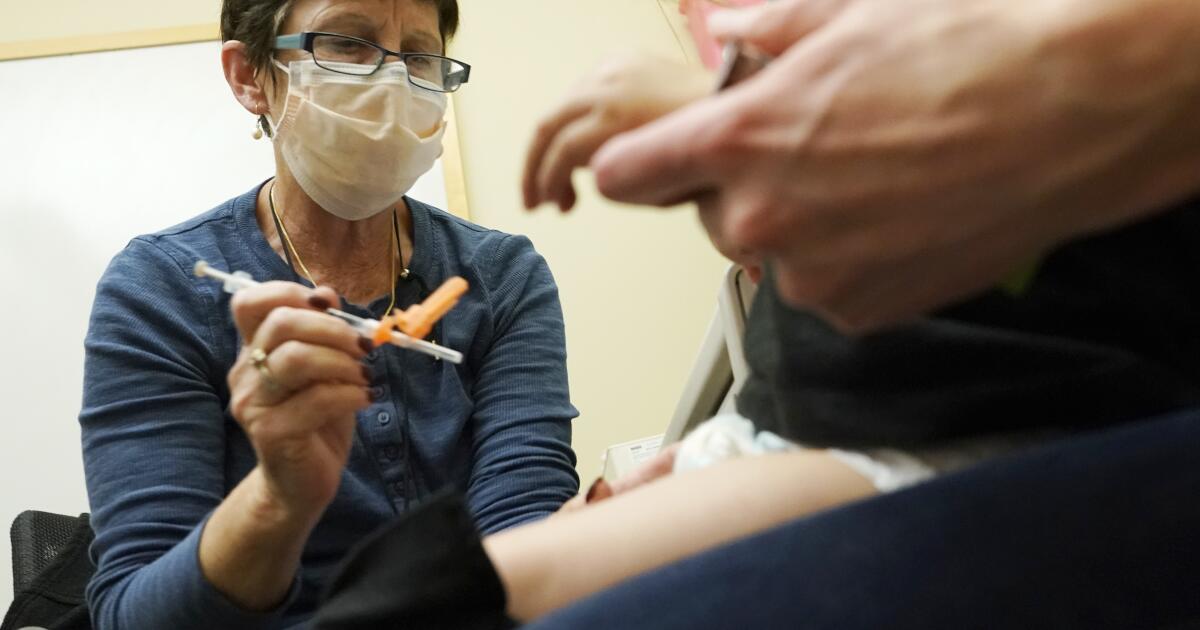
What do we owe children in the foster care system? At a minimum, safety. Which is why it’s so concerning that the Trump administration recently omitted guidance on vaccine requirements for foster homes. Given that the secretary of the Department of Health and Human Services has well-known reservations about the efficacy of vaccines, maybe this development isn’t surprising. But that doesn’t make it any less dangerous.
The federal government doesn’t license foster homes — that is the job of states. But the federal Administration for Children and Families does provide guidance about that licensing, and given that the feds provide about half the money that states spend on child welfare, it’s a safe bet that many states align their priorities with federal expectations.
In 2019, during the first Trump administration, the federal guidance for foster homes required that all children living in the household must “be up to date on immunizations” and that all household members “who will be caregivers of infants must have an up to date pertussis (whooping cough) vaccine” and, if caring for an infant or child with special needs to have a current (annual) flu vaccination. The 2026 standards specify none of these.
A disproportionate number of children in foster care are medically fragile, meaning they may be particularly vulnerable to these diseases. The idea that the unscientific views on vaccines by parents should trump the safety of children is a gray area legally, but there is no world in which foster parents should be following woo-woo ideas about medicine when it comes to children who are in their custody only temporarily.
People are free to embrace fringe medical beliefs. But many are trying to exert pressure on government and nongovernmental agencies to abandon vaccine guidance for other people’s children. Children’s Health Defense, the anti-vaccine group Robert F. Kennedy Jr. led before joining HHS, is suing the American Academy of Pediatrics for its recommendations. Its lead plaintiff is a mother just charged with murdering her twins. She claims vaccines killed them.
To be clear, medical consent for a child in state custody is not automatically handed to a foster parent. Still, routine medical decisions — what most vaccinations are considered — are going to be made by the person who takes the child to the doctor. That is going to be the foster parent, which is why Arizona has issued guidance that: “licensed foster parents cannot impose their vaccine hesitancy beliefs on foster children” and makes explicit that they are “not authorized to request a school or child care vaccine exemption for a foster child.”
Of course, this is not the first attempt to politicize foster care licensing. As part of the licensing procedure, a number of states including Massachusetts and Oregon have demanded that any potential foster parent — even someone being licensed to care for an infant, even someone licensed to care for their own relative who has no interest in gender transitions — promise to respect gender-affirming care sought by any foster child. The Biden administration also tried to issue guidance along these lines, restricting the ability of states to contract with faith-based agencies that didn’t support LGBTQ+ youth in the way the government deemed acceptable.
The Trump administration’s change of views on vaccines seems to be part of a larger push to loosen the requirements for foster parents, without prioritizing children’s safety. The 2019 standards provide that an applicant must have had a physical within the last 12 months, with a licensed healthcare professional indicating the applicant could care for an additional child. That year’s guidance adds that all household members must disclose current mental health or substance use issues, as well as any history of drug or alcohol abuse or treatment.
The 2026 standards dispense with any professional medical evaluation and replace this standard with self-disclosure: The applicant, and any other adults living in the home, are asked to report current physical limitations and mental health and substance use issues that might limit the ability to care for children. The new standards also drop all references to physical and mental health history. As long as the applicant does not self-define the problem as “current,” there is nothing to disclose or consider.
Do we really think that an active drug user is going to volunteer this information? Is it not worth checking their claims when we are considering whether to license and pay them to care for a vulnerable child who has already been abused or neglected? And should a decades-long history of drug addiction not count, simply because the applicant has been clean for a few months?
It seems that the Administration for Children and Families has lost the plot. The agency also recently recommended that states loosen requirements for criminal background checks on foster parents — as long as they were considered kin. Not only should states not automatically disqualify potential caregivers with criminal and even violent criminal histories, according to the latest guidance, they should also take into consideration character references and whether criminals had completed court-mandated rehabilitation when determining whether to license people as foster parents. The loopholes are big enough to drive a truck through.
What all of these changes have in common is that they are not being made with the health and safety of children in mind. They are being driven by political agendas. Politicians and the growing ranks of advocates who have deep pockets and unfettered access see foster parent licensing as an opportunity to impose their social agendas — whether to argue that gender is fluid, vaccine mandates are too intrusive, drug use is just another lifestyle choice, it’s unfair to hold someone’s criminal record against them. But these changes lose sight of the reason we have foster parents in the first place. Children were in danger and they are in need of protection. Our political leaders should save their ideological crusades for another day.
Emily Putnam-Hornstein is a professor at UNC Chapel Hill’s School of Social Work. Naomi Schaefer Riley is a senior fellow at the American Enterprise Institute. They lead Lives Cut Short, a project to document child maltreatment fatalities.
The post Keep antivax politics out of foster parent licensing appeared first on Los Angeles Times.