
In this installment, we dive into the world of family offices, private firms that handle the assets of the rich that have increasingly become a financial pipeline into Hollywood and answer the question: How do you access that wealth?
When a big-time CEO or a family that founded a massive company reaches the pinnacle of success, they don’t simply walk into a bank or talk to any financial advisor. For the ultra wealthy, there are family offices, which are small, private firms that manage the money of a single or small number of families and individuals. Collectively, they represent a huge pool of money that often flies under the radar.
Some families may want to devote their money towards leaving a positive impact on the world through philanthropic endeavors. Others may be seeking investment guidance or resources to ensure their next generation is set up for success.
But increasingly, some family offices are putting their money to work within Hollywood, whether in acquiring IP or a sports team, funding a TV show or film or helping build a brand. Over the last two years alone, $22.2 billion has been directly invested in media and entertainment.

“Family offices’ longer-term approach can be particularly valuable in entertainment, where intellectual property and media assets may take years to fully monetize,” said Carolyn Hunt, an entertainment attorney at Barnes & Thornburg. “They are often more willing to support creative, unconventional or relationship-driven opportunities that may not fit traditional studio or lender models.”
In this piece, we unlock the mystery of how family offices work. To break down everything you need to know, TheWrap spoke with several experts on the topic, who provided the following key insights:
- The typical single or multi-family office is launched by families with a net worth of around $100 million, though some only see it as economically justified at a net worth of $500 million or more.
- When compared to traditional financing sources, family offices offer more patient capital and are looking for a compounding, long-term investment. They have fewer layers of required approvals, allowing for faster decision-making.
- A family office’s investment decisions are flexible based on client preferences, but generally lean towards long-term value creation opportunities, such as IP ownership or building a multi-platform brand. Or the investment could be driven by a mission, value or social impact, like funding a documentary about climate change.
- While family offices tend to operate under the radar, the easiest way to connect with them is through an existing mutual relationship, such as a traditional bank or investment firm, accountant, attorney, agent, manager, business manager, producer or investor .
Welcome to Trade Secrets, TheWrap’s insider guide to making it in Hollywood. In previous installments, we’ve shared industry knowledge about how to get a TV show or film greenlit, how to break into a writers’ room, get into a film festival and find representation.
What is a family office?
A family office manages all aspects of so-called ultra-high-net-worth individuals or families. Their services can vary widely depending on a family’s goals, but can range from managing bills, private property, investment portfolios, contracts and deals to tax and estate planning, risk management and philanthropy.
Specifically within media and entertainment, their services generally cover structuring entertainment income streams, residuals and royalties, back-end participation planning, loan out corporation management, production company acquisition or exit planning, slate financing and co-investments, to name a few.
“Of all the industries I work in, the entertainment industry has the most bumpy, choppy income stream, even more so than startup companies,” said Kerry Finn, a wealth advisor at multi-family office Sequoia Sentinel, which manages around 35 different clients. “Your regular income and IP can appreciate over decades and you’ll get paid out down the road. You’ve got back-end deals that can hit years later. You’ve got production companies that could be worth a lot today, but if you lose some talent can be worth zero tomorrow. So planning on ways to smooth out the income for clients and the tax ramifications are very important.”
How much money does someone need to start, operate or work with a family office?
Experts peg the operating cost just to manage a small family office at anywhere between $500,000 to $5 million per year. That includes employing a chief investment officer, chief financial officer, tax and estate planning advisors, accountants and technical and concierge staff.
In addition to a single family office, there is also the option of a multi-family office, which can pool the resources of anywhere from five family clients to over 100 depending on its staff size, lowering the investment risk and barrier to entry. There’s also virtual family offices, which serve more as a coordinated network of independent specialists without the minimum thresholds or built-in cost floor of the other two models.
So even if you’ve seen some success in Hollywood, a family office may not be for you.
“If you’re an actor in Hollywood making $3 million a year, it’s not cost effective for you to set up your own family office. You’re better off just having a high quality business management firm,” said Lou Taylor, the president of business management firm and multi-family office Tri Star Sports and Entertainment Group. “It really doesn’t start to make a lot of sense unless somebody has $100 million net worth or more to stand up a single family office. That disqualifies a lot of people in the entertainment business right out the gate.”

While emphasizing that every family office situation is different, Finn put the estimated range for a single family office at roughly $100 million to $250 million in investable assets and a net worth of roughly $250 million to $500 million.
As for a multi-family office, he pegged the investable assets at roughly $25 million to $250 million and the net worth at roughly $50 million to $500 million. For a virtual family office, he estimated that investable assets range from roughly $5 million to $40 million and that the net worth ranges from roughly $10 million to $75 million.
“There are some in the camp that a true family office is only justified economically over a $500 million net worth,” he added.
Where do family offices typically invest within media and entertainment?
When it comes to entertainment, opportunities can range from television and film productions, music catalogs, sports, gaming, live entertainment and experiences to digital and social media, AI and the creator economy.
“We’re seeing families and family offices really not tending towards the more traditional investments. They often outsource those, but look to build verticals in sports, entertainment and media, in AI, in real estate,” Julie Zorn, the head of CAA’s Global Family Office Advisory, said. “We also find some of the next-gen family members are interested in investing through their foundation into purpose-driven opportunities. Perhaps a documentary around global climate change or a film financing that would have some type of social impact.”
Meanwhile, the size of a family office’s investment depends upon the willingness or tolerance for risk and their existing relationship with those behind the project, brand or company.
“They may put in $50 million to $100 million if they have sufficient assets to do that. But honestly, I’m seeing smaller tranches like $1 million to $5 million into multiple projects,” Finn said. “If the aggregate is $100 million liquid, we may be advocating 20% to 30% in alternative investments depending on what their risk is. So up to $30 million could be allocated to a pool of investments like various IPs, movie deals, etc. They may not want to put all of it into the movie industry, they may want to put half and half or something like that.”
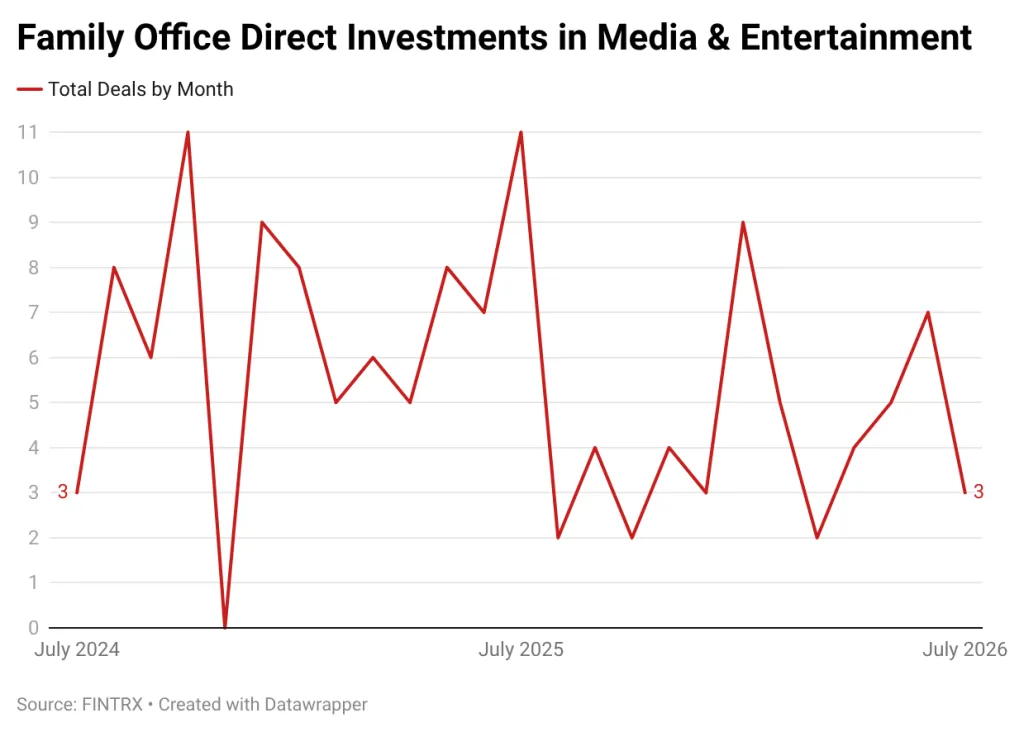
Over the last two years, there have been a total of 137 investments across 123 media and entertainment portfolio companies, with an aggregate value of $22.2 billion, according to the private wealth intelligence platform FINTRX.
Out of the 137 investments tracked, there were 37 in 2024, 65 in 2025 and 35 happened between January and July 1. There have also been a total of 22 “follow-on investments” over the last two years, where a family office puts more capital into an existing investment.
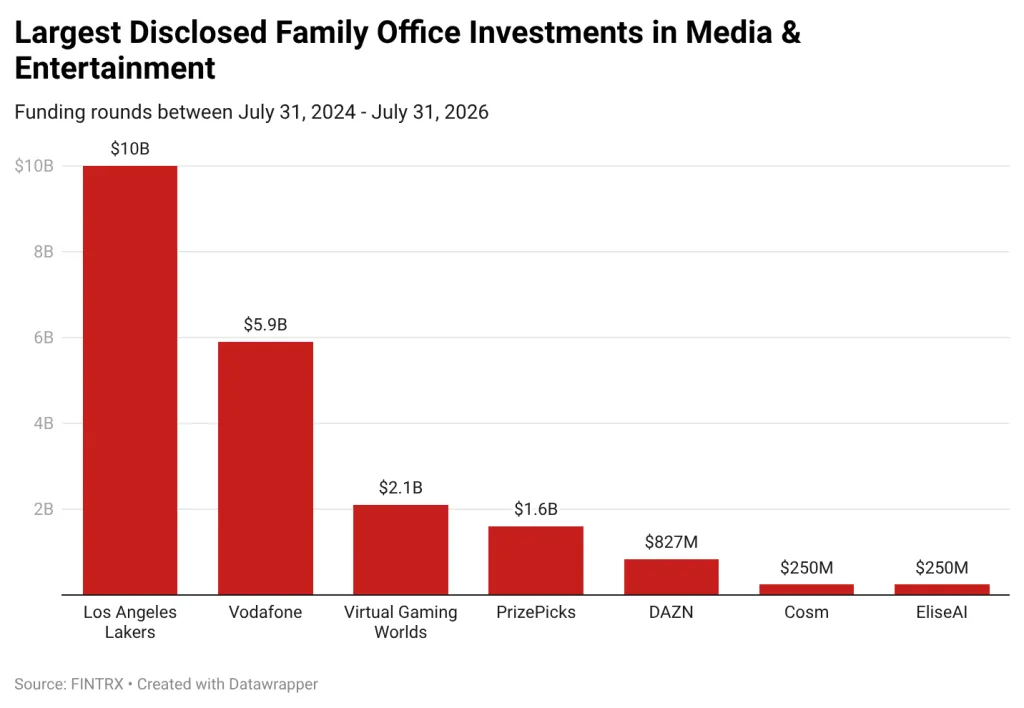
The top five largest disclosed investments ranged from $827 million in DAZN from Len Blavatnik’s Access Industries to a $10 billion investment in the Los Angeles Lakers from TWG Global, the family office of Mark Walters, who acquired majority ownership of the team from the Buss Family.
How do I get connected with a family office?
While family offices intentionally operate under the radar, the easiest way to break through is with a mutual connection. For Hollywood, that can range from a traditional bank or investment firm to an accountant, attorney, agent, manager, business manager, producer or investor.
“If I have a family as a client, I will work with them to understand their needs and their goals and how best to connect them to external resources and we’ll make those introductions when appropriate,” Zorn explained. “CAA has the agency side and we also have our sports division that helps families looking at buying into sports teams and leagues, branding and sponsorships and building stadiums.”
Another way to find family offices is through FINTRX’s AI-powered subscription platform, which offers a database of roughly 4,500 family offices and more than 30,000 contacts globally. Family offices included in the database have a minimum asset threshold of $50 million.
“We’re seeing more and more different players showing up into the space and it’s only going to continue to expand,” FINTRX research associate Patrick Galvin said. “The United States are the leaders in it, but we’re seeing other countries also grow at the same time. So it’s really a booming industry.”
Meanwhile, for existing family offices that are looking for investment advice or co-investors, they can attend several conferences throughout the year that are hosted by large institutions or groups of family offices. There are also peer network groups such as Family Office Exchange or Tiger21.
What are the advantages of a family office vs. other funding sources?
One of the most notable benefits of a family office is the speed and flexibility with their investments, given that they have fewer required approvals and layers of bureaucracy than traditional financing sources.
“They are not managing outside limited-partner capital and generally face far less quarterly reporting pressure than private equity firms, hedge funds or banks,” Hunt said. “This flexibility allows them to move quickly and sometimes support projects that fall outside traditional studio or financing models.”
“Decisions happen in weeks with just a small team all working together,” Galvin added. “They also have very patient capital. So where other institutions might have a hard exit mandate and have to leave an opportunity at a certain point, family offices aren’t like that. They can hold through volatility, they have extended timelines without any pressure to redeem the benefits or leave early.”
Family offices also prefer investing in the industry where they obtained their wealth from, given that they have existing relationships to partner with, plus more expertise, confidence and a personal connection. This allows them to provide advisory services to help companies and brands with their next steps, such as making introductions to other co-investors or industry-specific contacts.
“They’re going to want to know what a founder’s like, their character, their integrity. Are they going to have a long-term relationship with this person?,” Taylor said. “They’re not going to be so focused on what’s the exit, what’s the five-year turn?”
What about the disadvantages?
However, it’s important to keep in mind that access to their capital is more limited than traditional financing sources.
“If they believe in the product, in the story, in the team, then they’re more willing to put whatever check size is needed,” Galvin added. “But it’s case by case. Some are more willing for the larger checks, whereas some prefer smaller checks.”
Their investment decisions can also be influenced by personal interests, values and family dynamics. Depending on how their governance is set up, you could be dealing with just the patriarch or matriarch of a family or multiple generations.
“When you’re dealing with a private equity firm, it has the tendency to be less emotional, whereas a family might be more emotional. That can be both good and bad, because they can make a decision on gut instinct,” Greg Suess, co-founder and head of the family office practice at consulting firm Activist, said. “You’re dealing with somebody’s personality and you’re at the whim of what that person decides to do. If they decide to make a different decision from the one they made yesterday, you’re going to have to live with that.”
Hunt also emphasized that not every family office has the same level of expertise when it comes to investing in this field.
“Some underestimate the complexities of content financing, distribution, marketing and the long timelines often required to monetize projects successfully,” she warned.
Who are some prominent examples of people who use family offices?
While they won’t advertise it, many prominent figures across tech, media and entertainment use family offices.
Executives who have a family office include Bill Gates, Jeff Bezos, Michael Dell, Elon Musk, Larry Ellison, Byron Allen, Len Blavatnik, Ron Burkle, the Murdoch and Dolan families, Gigi Pritzker, Laurene Powell Jobs, Steve Cohen and Black Bear Pictures’ Teddy Schwartzman.
Celebrities and athletes like Oprah Winfrey, Charles Melton, GiGi Pritzker, Serena Williams, Beyoncé and Jay-Z, Tom Brady, Tiger Woods, George Lucas and Jason and Kylie Kelce also use family offices, among others.
Over the two-year period tracked by FINTRX, the most active family offices in media and entertainment were a16z Perennial with 12 investments, followed by Bolt Family Office (6), Blue Pool Capital (3), Rock (3), KKCG (3), Dragon Global (3) and Kohli Ventures (3).
The post Unlocking Family Offices: Hollywood’s $22 Billion, Under-the-Radar Pipeline appeared first on TheWrap.