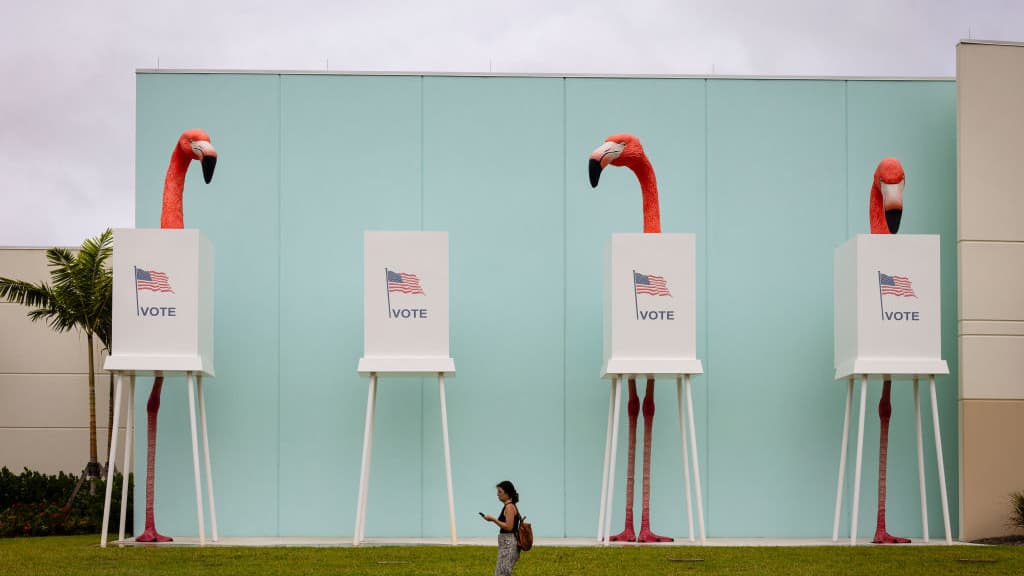
On Tuesday, Democrats flipped traditionally Republican states in places many considered out of reach. As I watched the returns come in from my apartment in Brooklyn, I wondered whether Florida, my home state, would also turn blue.
In the end, Republicans won most of Florida’s major statewide races––one of the few losses Democrats suffered. On the surface, the sea change that swept through the country appeared to have missed Florida. But Democratic candidates here didn’t lose by much, and that distinction paints a more complicated picture of Florida’s electorate.
The results challenge the assumptions about the political limits of progressives in the state. With 2028 approaching, Democrats need to start building a new movement in Florida now.
The results were very close
On election night, Alfred Soto, an associate teaching professor of communications at Florida International University, was momentarily buoyed as he watched the vote count with friends in Miami. For years, Soto mobilized voters as part of the Cuban American Democrats, before the organization disbanded earlier this year. “As I saw those early returns, I thought, can we do this? Is this possible?”
Early returns showed Democrat David Jolly, the candidate for governor, leading Republican Byron Donalds, and Angie Nixon, the Democratic nominee for U.S. Senate, appeared to be locked in a tight race. In Miami-Dade County, where I grew up, it looked as though the Republican Rep. María Elvira Salazar could lose her House seat. And Republican Rep. Mario Díaz-Balart’s race initially looked reassuring, but later reporting revealed a much more competitive contest.
Jolly came within roughly 1 point of winning the governor’s race, while Nixon came within roughly 3 points of flipping a U.S. Senate seat. Every county in Florida, except one, moved blue—in some cases, by double digits.
Miami-Dade County had the highest voter turnout in a midterm election in more than two decades, and the country flipped blue after voting Republican in 2022.
As I write this, Salazar’s race has entered a recount and though Díaz-Balart has claimed victory, that race remains too close to call. It is a stunning turn of events when you consider that they are two longtime Republican incumbents running in heavily Hispanic districts.
Nixon’s performance was particularly notable given the circumstances of her campaign. She was outspent by Republican-aligned outside groups, running in a state Trump carried comfortably in 2024.
Many Cubans, who make up the largest share of voters in the city, cringe at the mere mention of socialism. And yet, Nixon made huge headway campaigning on an agenda that included Medicare for All, universal childcare, and other democratic socialist priorities.
“It left me more energized than ever,” Soto said. “I thought, okay, maybe Florida now is where Texas was in 2018, 2020.”
Latinos in Florida are feeling the impacts of Trump’s policies
Many Florida families have been battered by the Trump administration’s immigration policies. Haitians in South Florida who lost Temporary Protected Status have lost their jobs and are afraid to step outside. In Doral, where there is a strong Venezuelan community, some businesses have shuttered, and local officials are facing pressure over the city’s cooperation agreement with ICE.
It’s true that Cubans and other Latinos in Miami supported Trump’s deportation policies and have stood by the Republican Party. But some have come to regret that support, and in part this election’s results bear that out.
And it’s not just immigration. South Florida is now considered one of the most expensive places in the country.
Groceries are where Elisa Douglass, a jewelry-maker in Miami, feels it most. Her family used to spend about $150 a week on groceries. Now she shops at two or three different stores depending on what is on sale, and the bill is closer to $380.
“The difference is crazy,” she said. Even a small pack of Bustelo coffee (a staple in many Latino households) costs $8. Her elderly parents, who live off $32,000 a year, lost their Medicaid as a result of recent federal policy changes and administrative cutbacks.
To win Floridians in 2028, Democrats need to acknowledge, and promise to address, bread-and-butter economic challenges like these head-on. They need to make the casethat protecting immigrant families and creating legal pathways for people who want to contribute to this country are in America’s best interests.
How Florida is changing
To be sure, Florida has shifted in recent years. Senator Rick Scott and Gov. Ron DeSantis have shaped who moved to the state and changed how voter rolls were maintained. On paper, the state became much safer for Republicans.
“It’s still a very Republican electorate at the end of the day,” Carlos Odio, a co-founder of Equis Labs said. Still, he cautioned, “you can’t start with the default assumption that Florida’s off the table.”
Díaz-Balart nearly lost in a race that few people were focusing on or talking about. In Orlando, Democratic Rep. Darren Soto appeared to be holding on in a district redrawn after the Supreme Court’s Callais decision, which split the area’s Puerto Rican community across several districts and dropped his seat’s Hispanic share to about 36%.
Rep. Alexandria Ocasio-Cortez stumped for Nixon’s campaign. “We need to be pulling up for these candidates in the south,” she said in a video posted on Instagram.
But to fund a serious program in Florida, national Democratic groups would need to focus on year-round organizing, instead of concentrating most of their efforts around election time. This matters especially because Florida has over 5.6 million registered Republicans, more than 4.1 million Democrats, and over 3.3 million with no party affiliation. Reaching and persuading even some of those unaffiliated voters could make a real difference in statewide elections.
‘Walking away has its own costs’
Chuck Rocha, the political strategist behind many Democratic wins this election, said his group spent “more than $2.6 million on Spanish-language ads, media and mail over three to four months,” and that Latino voters overperformed. “When you invest,” he said, “you can see the outcomes.”
Rocha argued that winning statewide would take longer-term investment, because many young Latinos are just becoming eligible to vote, and many are frustrated with both parties. That means reaching them on streaming services and YouTube, not network TV, to “remind people why their life sucks, and who’s to blame, and what you’re going to do to fix it.”
But ads are only one piece. Democrats also need groups working in communities on issues like immigration and food insecurity, he said, outside election season. Showing up for Floridians outside of election season will build trust.
“The mantra was always: Florida’s too big, too complicated, too expensive,” Odio said. “But walking away has its own costs.”
The post How Democrats Can Win Florida in 2028 appeared first on TIME.