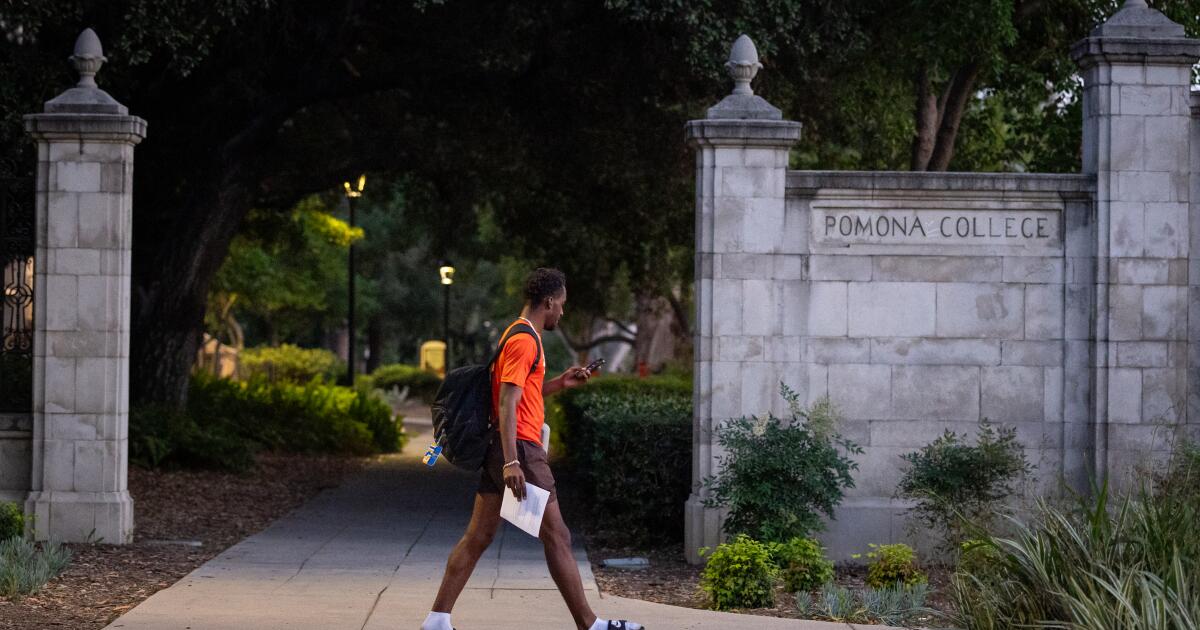
Pomona College in Claremont has long projected the ideals of a liberal arts education: elite academics, small classes and deep student-faculty ties against a backdrop of lush courtyards at one of the nation’s most selective campuses. That image is now under strain.
A series of anti-Black incidents has unsettled the campus, raising questions about race and belonging. This year, multiple students have shouted or sung the N-word at athletic events and in residential halls, and held a party where attendees were invited to dress as Black stereotypes. Criticism is growing over a professor’s use of the slur in class. Vandals damaged a campus lounge popular with Black community members.
Students have also pointed to Fizz, an anonymous app used by Pomona students and those across the other neighboring undergraduate Claremont Colleges — Pitzer, Harvey Mudd, Claremont McKenna and Scripps — as a place where racist posts regularly circulate.
The college has confirmed the cases took place and are under investigation.
“Pomona College does not care or protect their Black students,” said a recent Instagram video from the Black Student Union that was shared thousands of times.
Black students say the racist episodes are not isolated but part of a pattern that has eroded trust as national politics intensify scrutiny of diversity, equity and inclusion efforts and, in particular, Black and Latino student enrollment at elite colleges.
“I grew up in suburban Indiana, so I thought I was used to being one of the few Black people around and the snickers and sneers,” said Kourtney Jennings, a junior majoring in media studies and politics. “What I did not expect is to encounter such in-your-face racism in Southern California.”
Pomona leadership
Pomona President G. Gabrielle Starr acknowledged the strain in a campus message this month, citing “deeply troubling accounts of racist incidents.” She added: “I take these concerns seriously, and I know our community does too. Addressing them requires sustained engagement.”
A recent message signed by two campuswide deans and a chief operating officer said, “Racism has no place at Pomona College. It is antithetical to our educational mission and damages the sense of belonging that every member of our community deserves.”
College leaders said they are expanding trainings on bias reduction and cultural awareness for students, faculty and staff, including athletics teams. Officials said they are working with the six other Claremont Colleges to weave anti-bias training into the rhythms of campus life — from orientation and leadership programming to student organization programs.
The conflict is unfolding at a campus whose top leaders know what it is like to be Black on campus. Starr is among a small group of Black female college presidents in the U.S. The dean of students, the athletics director and the dean of admissions and financial aid are Black.
“As a Black administrator, these concerns do feel close to home,” Avis Hinkson, the vice president for student affairs and dean of students, said in an interview. She acknowledged that “these kinds of experiences are happening more frequently, across both the higher education landscape and the country more broadly.”
Hinkson said campus investigations could end in probation, suspension and possibly expulsion.
“When concerning incidents don’t rise to the level of targeted threats, intimidation, harassment or discrimination, the college relies on more of an education-oriented restorative process. … Students, in particular, aren’t always aware of how their words or actions affect others. Through this process, we have the opportunity to help students build awareness and skills they’ll carry with them beyond Pomona.”
“We know that outcomes don’t always align with individual expectations, and that can be frustrating — particularly when there are privacy limitations on what the college can publicly say,” Hinkson said.
Danielle Lynch, who is Black and started her job as the Pomona-Pitzer athletics director this month, said she has begun meeting with athletes because “sometimes we assume that people understand what they’re saying and what they’re doing and they, in fact, do not. Athletics can shift culture.”
The developments take place at a sensitive moment as admitted students weigh decisions and the college prepares to host a California gubernatorial debate April 28.
Student frustrations
Frustration is mounting over the pace of investigations. For some students, the visibility of Black leaders has sharpened expectations. Some believe administrators are focusing on teaching moments over discipline. Adding to tensions: the challenge of identifying wrongdoers when racism takes place on anonymous forums or in private spaces before accounts spread via social media or word of mouth.
At a recent campus town hall organized by the Black Student Union, hundreds gathered to vent and strategize. Students described incidents ranging from micro-aggressions to explicit racism, including a Snapchat post depicting Black students as slaves and monkeys. Students said a professor’s use of the N-word in a classroom discussion after a documentary where the word was said — instances the college verified — was among the most disturbing.
“There will be times in our classrooms when engaging with difficult language is unavoidable. It is up to us to approach these moments not only with care, but also with awareness of both the historical and contemporary impacts of this language,” college leaders said in a statement after student complaints.
In interviews, Black students said the climate has worsened since President Trump took office. Jennings described two experiences in downtown Claremont and on campus where people — she was not sure if they were students — shouted Trump’s name at her along with racist slurs. Others said they have been targeted by similar outbursts.
In classrooms, Jennings said, professors have questioned her abilities in ways she believes her white peers do not experience. “I’m surprised you got a good grade on this,” Jennings said, paraphrasing her teachers.
The Black Student Union has called for the college to create an office to independently respond to reported bias — in addition to the existing formal campus complaint process. It also wants greater transparency in investigations, stronger consequences and more funding for Black student campus programs and Africana Studies.
Some faculty members echoed student concerns.
“I stand in solidarity with the Black Student Union and students across campus who are courageously speaking out against anti-Black racism,” said J Finley, an associate professor of Africana studies. “Their activism is important, and their efforts represent a meaningful and positive push toward a more just and inclusive campus.”
Many students, who were in high school during the 2020 racial justice protests and efforts at national healing after police murdered George Floyd in Minneapolis, said the tensions reflect years of unmet promises by colleges.
Aminah Augustin, a sophomore studying public policy analysis, said the campus initially felt welcoming. But it shifted to what she described as a steady stream of comments by non-Black students, including those who were not white, about her appearance, hair and demeanor. Part of the experiences, she said, was her growing awareness of being a minority on campus.
“I’m walking on eggshells because some of these people are my friends … and I have to see them every day,” Augustin said.
National climate
Senior class President Marilyne Makendi recalled first arriving on campus excited by a strong Black community. But she saw the Black population — 13.5% of her freshman class in 2022 — shrink as fewer Black students were admitted and others left.
With the recent incidents, “the climate has become worse,” said Makendi, an economics major.
The campus concerns also come as universities navigate the aftermath of the Supreme Court’s 2023 decision banning race-conscious admissions. Data from selective colleges show varied trends the year after the decision. Some, like Yale and Northwestern, saw increases in new Black student enrollment. USC and Stanford experienced declines.
Pomona reported a drop in Black students, who made up 9.8% of first-year students in 2023 and 5% in 2024.
In fall 2025, 29 students — or about 7% — of the 420 full-time first-year students were Black. Black undergraduates make up 151 — or just under 9% — of the total 1,721 students this academic year.
A campus spokesperson cautioned that changes in how applicants racially identify after the court decision make comparisons “potentially misleading.”
A chance for change
Some students see an opening for change. Augustin said recent meetings with Starr and other campus leaders made her “optimistic” that they were listening. “But when it comes to actual action, that’s where they’re falling short,” she said.
Tinarie Dacres, a Black Student Union member and sophomore who studies public policy analysis, said racism has felt more painful because of the close-knit, small campus where Black students are deeply involved in college life. He said it was “great” that administrators were “willing to help.” He stressed that the issue was bigger than Pomona.
Racism, he said, “isn’t something that’s new. It’s, in fact, a broader societal issue that has long been present in America.”
The post ‘In-your-face racism’ at an elite campus: Black students raise alarm at Pomona College appeared first on Los Angeles Times.