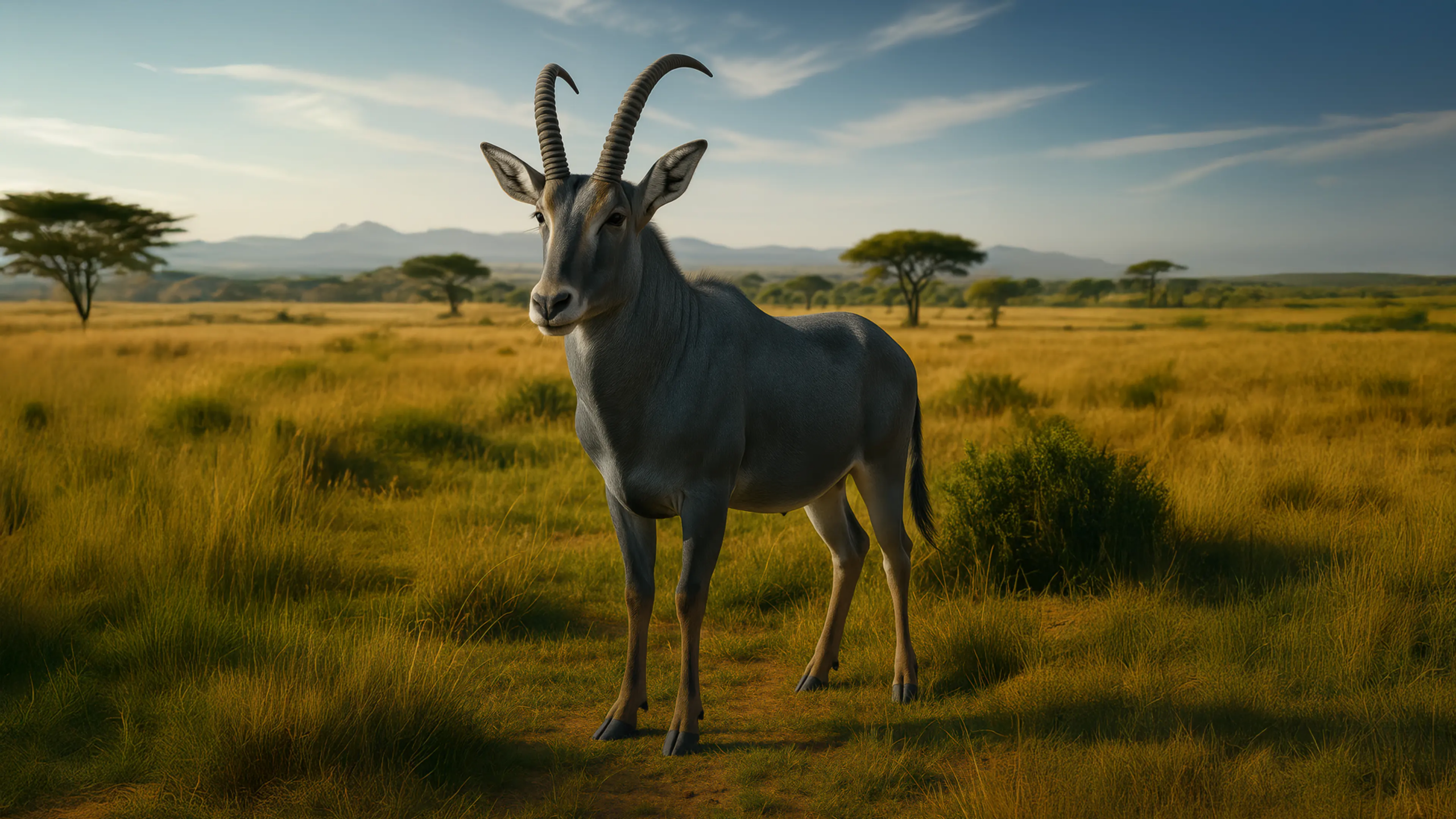
It’s been 226 years since humans last beheld a bluebuck—and we don’t know what we’ve been missing. The bluebuck was a species of antelope, but an especially elegant one—a trim, fleet beast, measuring about 4 ft. tall at the shoulders and 10 ft. from nose to rump, with long, sharp, backward curved horns measuring 22 inches from skull to point. Its belly was white and its face was brown, but the rest of the animal’s body was covered in a singular gray-blue coat. When it ran at its peak velocity of 50 miles per hour it resembled nothing so much as a speeding streak of pale blue sky.
That blue pelt was irresistible to the European colonists who poured into the bluebuck’s native South Africa, and it took them only about 150 years—from 1650 to 1800—to hunt the animal to extinction. Today the bluebuck exists only in drawings from the naturalists who saw it while it lived, and in stray specimens in science museums. Now, however, the bluebuck may be on its way back, thanks to Colossal Biosciences, the company that last spring made headlines with the news that it had de-extincted the dire wolf, which last walked the Earth more than 10,000 years ago and now prowls again in the form three young snow-white canids produced by editing the genome of a common gray wolf to express the traits of its dire wolf cousin. The company is also working to bring back the woolly mammoth, the Tasmanian tiger, the dodo, and the moa. Today it announced that the bluebuck would join that lost menagerie.
“African antelopes have long been neglected in global conservation,” said Beth Shapiro, chief science officer of Colossal, in a statement. “The bluebuck de-extinction project changes that. We’re bringing back a species that played a vital role in its ecosystem, and building the scientific foundation for antelope conservation before more of its relatives are lost.”
The need is urgent. Of the 90 antelope species in the world, 55 are experiencing declining populations and 29 of those are threatened with extinction. Colossal’s goal is not only to bring the bluebuck back, but to use the genetic techniques it masters in those efforts to fortify existing endangered populations.
Colossal researchers will do their work by first sequencing the genome of both a bluebuck and its close surviving relative, the roan antelope, looking for the differences that distinguish one species from the other. The roan cells are easy enough to collect—plenty of the animals are at large in sub-Saharan Africa in the west, central, and eastern parts of the continent. The bluebuck is another matter. To obtain the species’ DNA, Colossal researchers borrowed a tissue specimen from the Swedish Museum of Natural History and then conducted what is known as 40-fold coverage of the genome—sequencing each base pair 40 times to ensure genetic accuracy. The key spots on the genome that separate the lost bluebuck from the extant roan are unknown but they can be surprisingly few. For the dire wolf, the Colossal team had to make just 20 edits on 14 genes to give a gray wolf the dire wolf’s white coat, larger size, more powerful bite, more robust fat distribution, and other key traits.
Once the differences between the roan and bluebuck are determined, the researchers will edit the DNA in a roan cell accordingly. Then they will extract the rewritten nucleus from the cell, and implant it into a roan ovum that has been stripped of its own nucleus. That modified ovum will be allowed to develop into an embryo in a lab, and will then be implanted into a roan surrogate. After a 278-day gestation period, the roan mother will give birth to a bluebuck calf.
That work will not be easy. Overall, the researchers have found, the roan and the bluebuck differ by just 3% of their overall genome—but that 3% is represented by 18 million sequence variants. In theory, that would mean rewriting 18 million points of code to convert a living roan cell to a reborn bluebuck cell. But not all of those differences are relevant to the phenotype—or appearance—of the bluebuck that the Colossal team wants to recreate. Some may be genes that code for metabolic differences between the two animals; some may code for digestive functions; some may be promoter genes—or genes that don’t code for anything at all, but instead help regulate the behavior of other genes. The scientists’ job is to identify these less relevant genes and toss them out of the 18-million-item list of variants.
“We filtered them and got to about three million variants,” says Scott Barish, a Colossal genome engineer. “Then we got it down to 2.4 million truly functional regions of the genome, and then narrowed our focus to what are truly key phenotypes and got down to about 20,000. It’s so much more manageable but still an imposing number.”
Colossal is not saying if or when it will distill the differences down to the small number that made the dire wolf possible, but the company is already making progress in basic science that is advancing the overall field of genetic engineering. In the course of their research they have managed to re-engineer adult roan cells so that they become so-called induced pluripotent stem cells (iPSCs), inchoate cells that can develop into any one of the body’s multitudinous specialized cells—nerve cells, blood cells, cardiac cells, bone cells, and on and on. Having iPSCs on hand makes it possible to grow any type of bodily tissue and study how different genetic edits affect it, without having to experiment on a live animal.
“That matters enormously for species where every individual counts,” said Shapiro in a statement. “We’re building this platform for bluebuck but the conservation adaptations for living antelope species…are just as significant as the de-extinction work itself.”
Where the bluebucks will live once they’re at large in the world is another question Colossal is addressing. The three dire wolves the company created will live their entire lives in a 2,000-acre enclosure located in an undisclosed place to protect them from gawkers—or, worse, poachers. But the ultimate goal for Colossal’s animals would be for them to be released into the wild. For the bluebuck, the company is partnering with the nonprofit Advanced Conservation Strategies to navigate regulatory thickets in potential host countries where the animals could live on wild land with the proper vegetation and climate, in herds large enough to be genetically viable. That wilderness may or may not be in the bluebuck’s native South Africa, but if the animal does return, the hope is that it will be treated more gently now than it was in its first go-round.
“Bringing the bluebuck back is only half the work,” says Colossal CEO and co-founder Ben Lamm. “The other half is making sure the world is ready to protect it when it returns. That means working across governments, conservation organizations, and international regulatory bodies to establish formal protections that follow the bluebuck wherever it lives, not just in a single reserve, but across the southern African landscape it once called home.”
The post The Company That Brought Back the Dire Wolf Is Eyeing A Blue Antelope For Its Next De-Extinction appeared first on TIME.